
First Iranian Family Dinner: 12 Phrases for Survival (A2)
Your first Iranian family dinner is coming. You're terrified, and you should be — but not for the reasons you think. This is your language and culture survival guide for making it through the evening without accidentally insulting anyone, eating yourself into a coma, or calling your partner's dad "to" instead of "shoma."
My Italian friend Marco dated an Iranian girl for three months before she brought him home for dinner. He prepared by learning how to say “hello” and “thank you.” He thought he was ready.
This guide is part of our Learning Farsi for Your Iranian Partner series.
He was not ready.
By 9 PM, he’d been force-fed four plates of rice, kissed on both cheeks by an uncle he’d never met, and accidentally called his girlfriend’s mother “to” (the informal “you”) instead of “shoma” (the respectful “you”). The room went quiet. Not angry-quiet. Disappointed-quiet. Which, if you know Iranian families, is significantly worse.
Your first Iranian family dinner is not just a meal. It’s an audition. And the language you use. even just five or six phrases. will determine whether you pass or fail. I’ve watched this play out dozens of times with friends, students, and one very unfortunate Australian guy named Dave who tried to fist-bump my uncle. So here’s everything I wish someone had told Marco.
The Arrival: First Words Matter More Than You Think
You walk through the door. Shoes off. always, no exceptions, don’t even think about it. The host will greet you with Salam (سلام) and probably Khosh amadid (خوش آمدید), which means “welcome.” Your job is to respond warmly and immediately.
Say: Salam, khosh amadid… ya, kheyli mamnoonam. Wait, no. They said khosh amadid to you. You say: Salam, mamnoonam, lotf darid (سلام، ممنونم، لطف دارید). “Hello, thank you, you’re too kind.” The “lotf darid” is critical. It signals that you understand the game.
If the mom or dad extends a hand, shake it gently. If they go for the cheek-kiss, follow their lead. it’s usually two kisses for women greeting women, and a handshake between a man and an older man. But honestly, every family is different. Some are huggers. Some are formal. Read the room.
One thing is universal: use “shoma” (شما), not “to” (تو). Shoma is the formal “you.” To is the casual “you.” If you call your partner’s parents “to,” you might as well have walked in wearing a hat indoors at Buckingham Palace. It’s not that they’ll yell at you. They’ll just quietly decide you weren’t raised properly. And that opinion, once formed, takes approximately seventeen years to reverse.
The Tarof Trap: They Will Offer You Everything Three Times
Before we get to the food, you need to understand tarof (تعارف). If you’ve read my piece on how to say no in Farsi without starting a war, you already know the basics. But tarof at a family dinner is tarof on steroids.
Here’s how it works. The host will offer you something. tea, fruit, a seat, food, their firstborn child. You are expected to refuse. They will offer again. You refuse again. They offer a third time. Now you accept.
This is not optional. If you accept the first offer, you look greedy. If you refuse all three times, you look cold. The three-round dance is the correct protocol. My friend Dave accepted a plate of fruit on the first offer and ate the entire thing in two minutes. My aunt later described him as “goshne” (hungry), which in Iranian code means “his parents didn’t feed him properly.” Dave is a 34-year-old software engineer. Didn’t matter.
The magic phrase for declining (rounds one and two) is: Mersi, zahmat nemikeshid (مرسی، زحمت نمیکشید). “Thank you, don’t trouble yourself.” Say it with a smile and a slight hand wave. Then on round three, accept gracefully with a Mersi, lotf darid (مرسی، لطف دارید).
Sitting Down: The Sofreh and the Hierarchy
Iranian dinners often happen around a sofreh (سفره). a spread laid out on the floor or on a large tablecloth on the table. There’s rice, obviously. There’s always rice. If there’s no rice, you’re not at an Iranian dinner. There’ll be khoresht (stew), sabzi (herbs), salad, bread, and more side dishes than you can count.
Don’t sit down until they tell you where to sit. There’s a hierarchy, and you don’t know it yet. The father usually sits at the head. The guest of honor. which is you, the exotic foreigner dating their child. gets a good spot. Just wait for someone to say Befarmayid (بفرمایید), which is the all-purpose Iranian “please, go ahead.” Then sit.
Befarmayid is a word you’ll hear approximately 400 times tonight. It means “please sit,” “please eat,” “please come in,” “please take more,” and “please stop being so polite and just eat the damn food.” Context is everything.
The Food: What to Say (and When to Stop Eating)
The food arrives. It looks incredible because it is incredible. Iranian home cooking is not restaurant food. it’s better. Someone’s been in the kitchen since 6 AM. That tahdig (the crispy rice at the bottom of the pot) took forty-five minutes of anxious monitoring. Respect it.
When you take your first bite, you need to compliment the cook. This is non-negotiable. The phrase you want is: Daste shoma dard nakone (دسته شما درد نکنه). literally “may your hand not hurt,” which means “this is incredible, thank you for the effort.” This is the single most useful phrase at an Iranian dinner table. It compliments the cooking, acknowledges the labor, and scores you massive points.
If you want extra credit: Ghazatoon mahshar bood (غذاتون محشر بود). “Your food was divine.” Use “mahshar” (divine/spectacular) instead of just “khoob” (good). “Khoob” is what you say about gas station sandwiches. “Mahshar” is what you say about someone’s mother’s cooking.
Now, the hard part: they will try to feed you until you physically cannot move. This is love. I’m serious. In Iranian culture, food is how you express affection, and an empty plate is an insult to the cook. Your plate will be refilled before you finish it. The mother will hover. She will ladle more khoresht onto your rice when you’re mid-sentence. Fighting this is futile.
Your survival strategy: take smaller portions initially. Eat slowly. And when you genuinely can’t eat more, deploy the full Mersi Stop Maneuver. hand up, palm out, “Mersi, mersi, daste shoma dard nakone, dige jaah nadaaram” (I literally have no room left). You may need to invoke God: “Be khoda sir shodam” (به خدا سیر شدم. I swear to God I’m full).
It still won’t completely work. Accept that.
Table Vocabulary: The Survival Phrases
Here’s your cheat sheet. Memorize these before dinner. Practice in the car on the way there.
Befarmaayid (بفرمایید). “Please, go ahead.” You’ll hear this constantly. You can also say it back when passing a dish.
Nooshe jaan (نوش جان). “Bon appétit” / “May it nourish your soul.” Say this to others. If someone says it to you, respond with Salamat baashid (سلامت باشید). “May you be healthy.”
Daste shoma dard nakone (دسته شما درد نکنه). “May your hand not hurt.” The ultimate cooking compliment. Use it at least twice.
Ghazaa kheyli khooshmaze bood (غذا خیلی خوشمزه بود). “The food was very delicious.” Simple, effective, always appreciated.
Bebakhshid (ببخشید). “Excuse me / Sorry.” Use if you reach across someone, bump something, or need to ask for a dish to be passed.
Chand saalete ke…?. This one’s for when the parents interrogate you (they will). It means “how many years have you…?” They’ll ask how long you’ve been dating, studying, working, living abroad. Be ready. If your spoken Farsi is shaky, it’s perfectly fine to answer in English with a few Persian words mixed in. They’ll love the effort.
The Post-Dinner Ceremony: Chai, Fruit, and Interrogation
Dinner is over. You think you’re done. You are wrong.
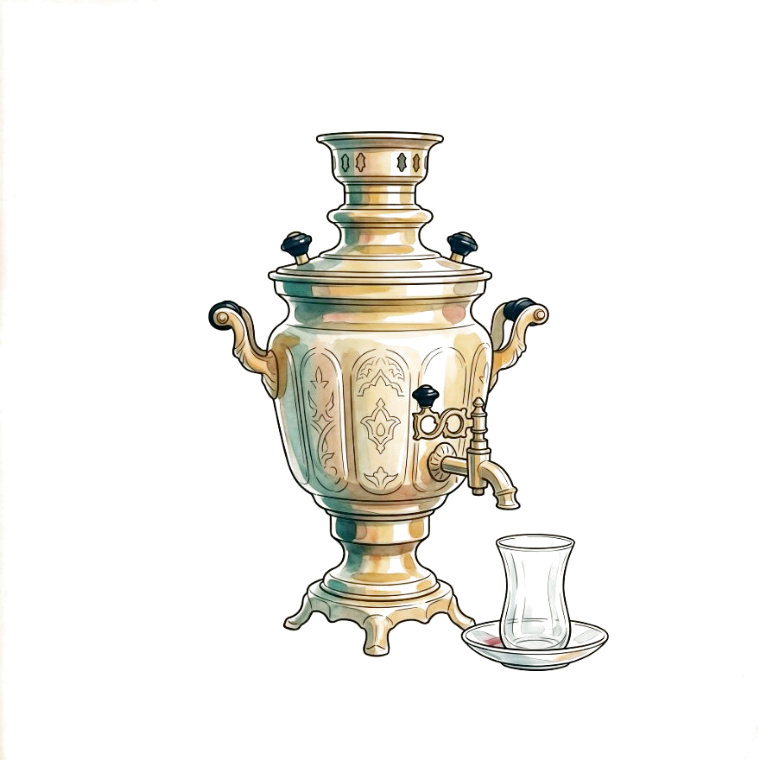
Phase two is chai (tea) and fruit. Someone will bring out a tray of chai (چای) in small glass cups, plus a spread of fruit. usually watermelon, grapes, pomegranate, or whatever’s in season. There will also be ajil (آجیل). mixed nuts and dried fruits. The chai is served with nabat (نبات). rock candy on a stick. or sugar cubes.
Pro tip: Iranians don’t stir sugar into their tea. They put the sugar cube between their front teeth and sip the tea through it. You don’t have to do this. But if you try it, they’ll love you forever. It’s called ghand pahlou (قند پهلو).
This is also when the interrogation begins. The parents want to know everything about you. What do you do? Where’s your family? What are your intentions? (They won’t ask this directly. They’ll ask “where do you see yourself in five years?” which means the same thing.) Stay respectful, use “shoma” relentlessly, and if you get stuck, just smile and say Bebakhshid, Farsi-am hanooz kam-e (ببخشید، فارسیام هنوز کمه). “Sorry, my Farsi is still limited.” They’ll switch to English or your partner will translate. Nobody expects fluency. They expect effort.
The Goodbye: Don’t Screw Up the Exit
Leaving an Iranian house takes a minimum of twenty minutes. This is not a joke. The goodbye process involves standing up, saying you need to go, being told to stay, sitting back down, having more tea, standing up again, moving to the hallway, being offered fruit “for the road,” declining, accepting, putting on your shoes, being offered a ride, declining the ride, being offered the ride again, declining again, accepting a container of leftover food (you MUST accept this, refusing leftovers is a war crime), and finally making it to the door.
At the door, the key phrase is: Kheyli mamnoon, vaghean zehmat keshidid (خیلی ممنون، واقعاً زحمت کشیدید). “Thank you so much, you really went to a lot of trouble.” This is sincere. They DID go to a lot of trouble. That meal took all day. Acknowledge it.
If you want to absolutely nail it, add: Inshallah ye rooz ma mezbaan bashim (انشالله یه روز ما میزبان باشیم). “God willing, one day we’ll be the hosts.” This implies future. This implies commitment. The mother will beam. The father will nod. You’ve won.
The Real Secret: They Already Like You
Here’s what nobody tells you. Iranian families are terrifying to outsiders, but they’re also some of the warmest, most generous people on the planet. The fact that you’re at their table means you’ve already been partially accepted. They want to like you. The food, the hospitality, the overwhelming attention. that’s not a test. That’s them showing you love the only way they know how: aggressively and with too much rice.
If you mess up a word, they’ll laugh with you and correct you gently. If you try to say “daste shoma dard nakone” and butcher the pronunciation, they’ll melt. The effort matters more than the execution. Every Iranian parent I know has said the same thing about their kid’s foreign partner: “At least they tried.”
So try. Be warm. Eat the food. Say shoma. And if all else fails, just keep saying Mersi until someone rescues you.
Know the names first: the complete family vocabulary covers all 50 Persian family terms. If you want to go beyond survival mode and actually start learning Persian properly, that’s a different project, but this dinner is a hell of a motivator. Nothing makes you want to learn a language faster than sitting at a table where everyone’s talking about you and you can only catch every fifth word. For more on learning Farsi specifically for your relationship, see our complete guide to learning Farsi for your partner.
Want to practice this vocabulary? Our app, ZabanYar, is coming soon.
And if you want personalized coaching on exactly this stuff. the family phrases, the tarof moves, the cultural landmines. book a trial lesson with me on Preply. I’ve prepped dozens of people for their first Iranian family dinner. Nobody’s died yet.
For more on the arrival and goodbye rituals at any Iranian gathering, read the arriving and leaving guide. If meeting the family sounds intimidating, One Scene a Week, Episode 13 walks you through the exact dialogue. from the doorbell to the goodbye. And for the sofreh itself, Cook Your Way to Farsi, Episode 17 covers how Iranians set the table and the vocabulary that goes with it.
Keep Learning
This guide is part of: Learning Farsi for Your Iranian Partner
Related: Why Iranian families are part of the relationship · Nowruz and Yalda with your partner's family
Read next: 50 Farsi Family Phrases · Iranian In-Laws Guide
New to Farsi? Start with the complete beginner's guide.
What should I wear to an Iranian family dinner?
Should I bring a gift to an Iranian family dinner?
How do I handle tarof at an Iranian family dinner?
Is it rude to leave food on my plate at an Iranian dinner?
What if I don’t speak any Farsi at my first Iranian family dinner?
Part of the Farsi for Your Iranian Partner's Family cluster.
Get it wrong and the worst that happens is a warm laugh and a story they’ll tell for years. Get it right — refuse the tea twice, accept on the third — and you’ll watch a face open up. You didn’t just speak Persian. You played the game.
A teacher from Tabriz, based in Milano. 5.0 on Preply across 52 reviews, 1,652 lessons taught. He curates the growing dictionary behind this site.
 Learn PersianRTL Script and Your Brain: The Neuroscience of Learning to Read PersianMay 2026Learn PersianFarsi for Journalists: Beyond Press BriefingsApr 2026
 Learn PersianThe 50 Farsi Phrases That'll Make Your Partner's Mom Love YouMay 2026
 Learn PersianFarsi vs Turkish: The Surprising ConnectionsApr 2026
 Learn PersianTa'ârof Is Not Politeness: The Cognitive Science of Iran's Social Operating SystemJul 2026Learn PersianIs Persian Arabic? Family, Words and Grammar ComparedMar 2026