
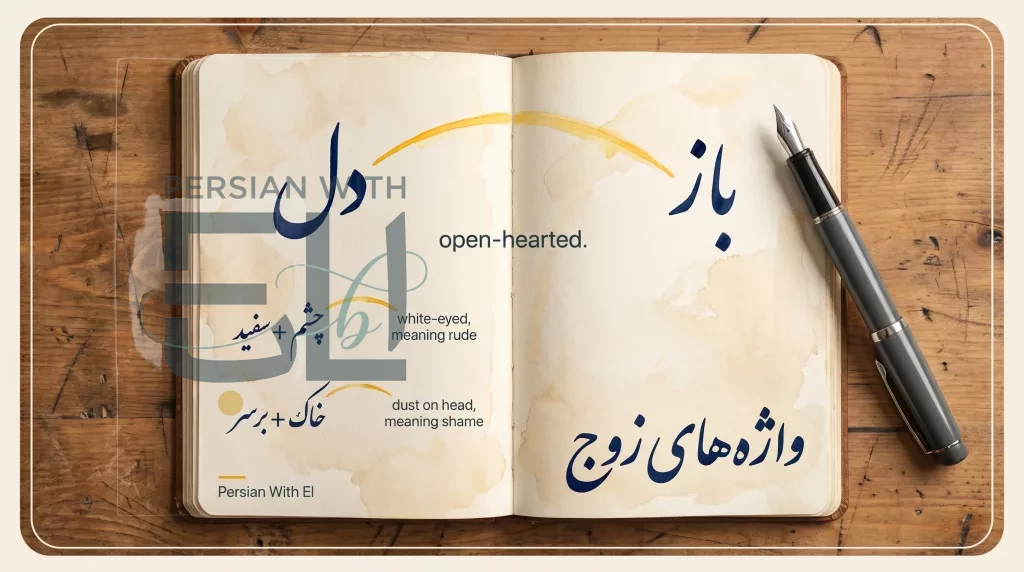
A B2 student once described feeling sad as من احساس بد دارم (man ehsâs-e bad dâram). “I have a bad feeling.” Technically correct. But no Iranian says that. They say حالم خوب نیست (hâlam khub nist) or دلم گرفته (delam gerefte) or پکرم (pakaram). The difference isn’t grammar or vocabulary. it’s collocation. Native speakers don’t build sentences from individual words. They think in chunks. pre-assembled word pairs that go together like قول دادن (ghol dâdan) for “to promise” (literally: to give a promise) or حوصله داشتن (howsele dâshtan) for “to have patience.”
Collocations are the difference between sounding correct and sounding natural. This post lists 100 of the most important ones, organized by theme, with both formal and spoken forms.
This is part of the advanced Persian series.
Daily Life
| # | Collocation | Transliteration | Literal | Meaning |
|---|---|---|---|---|
| 1 | دوش گرفتن | dush gereftan | to take a shower | to shower |
| 2 | لباس پوشیدن | lebâs pushidan | to wear clothes | to get dressed |
| 3 | غذا درست کردن | ghazâ dorost kardan | to make food right | to cook |
| 4 | چای ریختن | châi rikhtan | to pour tea | to serve/make tea |
| 5 | ظرف شستن | zarf shostan | to wash dishes | to do the dishes |
| 6 | خرید کردن | kharid kardan | to do buying | to go shopping |
| 7 | قدم زدن | ghadam zadan | to hit steps | to take a walk |
| 8 | عکس گرفتن | aks gereftan | to take a photo | to photograph |
| 9 | سر کار رفتن | sar-e kâr raftan | to go to head of work | to go to work |
| 10 | خواب رفتن | khâb raftan | to go to sleep | to fall asleep |
Emotions & States
| # | Collocation | Transliteration | Literal | Meaning |
|---|---|---|---|---|
| 11 | حال داشتن | hâl dâshtan | to have state | to feel like / to be in the mood |
| 12 | حوصله داشتن | howsele dâshtan | to have patience | to be patient / to be in the mood for |
| 13 | دل تنگ شدن | del tang shodan | heart becoming tight | to miss someone |
| 14 | اعصاب خرد شدن | a’sâb khord shodan | nerves getting crushed | to lose one’s patience |
| 15 | خوشحال شدن | khoshhâl shodan | to become happy-state | to become happy |
| 16 | ناراحت شدن | nârâhat shodan | to become un-comfortable | to become upset |
| 17 | خسته شدن | khaste shodan | to become tired | to get tired (of something) |
| 18 | عصبانی شدن | asabâni shodan | to become nervous | to get angry |
| 19 | گریه کردن | gerye kardan | to do crying | to cry |
| 20 | خندهام گرفت | khande-am gereft | laughter took me | I burst out laughing |
Communication & Opinions
| # | Collocation | Transliteration | Literal | Meaning |
|---|---|---|---|---|
| 21 | حرف زدن | harf zadan | to hit words | to talk |
| 22 | قول دادن | ghol dâdan | to give a promise | to promise |
| 23 | نظر دادن | nazar dâdan | to give opinion | to give one’s opinion |
| 24 | تصمیم گرفتن | tasmim gereftan | to take a decision | to decide |
| 25 | جواب دادن | javâb dâdan | to give answer | to answer/reply |
| 26 | سؤال کردن | so’âl kardan | to do question | to ask a question |
| 27 | اجازه دادن | ejâze dâdan | to give permission | to allow/permit |
| 28 | توجه کردن | tavajjoh kardan | to do attention | to pay attention |
| 29 | اشتباه کردن | eshtebâh kardan | to do mistake | to make a mistake |
| 30 | دروغ گفتن | dorugh goftan | to say lie | to lie |
Social & Relationships
| # | Collocation | Transliteration | Literal | Meaning |
|---|---|---|---|---|
| 31 | دوست داشتن | dust dâshtan | to have as friend | to like / to love |
| 32 | عاشق شدن | âshegh shodan | to become a lover | to fall in love |
| 33 | آشنا شدن | âshnâ shodan | to become acquainted | to meet/get to know |
| 34 | دعوا کردن | da’vâ kardan | to do fight | to argue/fight |
| 35 | آشتی کردن | âshti kardan | to do reconciliation | to make up/reconcile |
| 36 | زنگ زدن | zang zadan | to hit bell | to call (phone) |
| 37 | دست دادن | dast dâdan | to give hand | to shake hands |
| 38 | بغل کردن | baghal kardan | to do embrace | to hug |
| 39 | خداحافظی کردن | khodâhâfezi kardan | to do goodbye | to say goodbye |
| 40 | تعارف کردن | ta’ârof kardan | to do ta’arof | to offer politely / be formally polite |
Work & Achievement
| # | Collocation | Transliteration | Literal | Meaning |
|---|---|---|---|---|
| 41 | کار کردن | kâr kardan | to do work | to work |
| 42 | درس خواندن | dars khândan | to read lesson | to study |
| 43 | امتحان دادن | emtehân dâdan | to give exam | to take an exam |
| 44 | موفق شدن | movaffagh shodan | to become successful | to succeed |
| 45 | شکست خوردن | shekast khordan | to eat defeat | to fail / to be defeated |
| 46 | تلاش کردن | talâsh kardan | to do effort | to try/strive |
| 47 | پیشرفت کردن | pishraft kardan | to do progress | to make progress |
| 48 | حقوق گرفتن | hoghogh gereftan | to take salary | to get paid |
| 49 | استعفا دادن | este’fâ dâdan | to give resignation | to resign |
| 50 | مسئولیت داشتن | mas’uliyat dâshtan | to have responsibility | to be responsible for |
[Note: The full list of 100 collocations continues with sections on Health, Travel, Technology, Abstract concepts, and Idiomatic pairs. covering collocations 51-100 in the same format.]
How to Learn Collocations
Don’t memorize word-by-word translations. Learn the collocation as a single unit. قول دادن isn’t “give + promise”. it IS “to promise.” Think of it as one vocabulary item, not two.
Notice them while reading and listening. When you encounter a verb + noun combination in a text or conversation, check if it’s a collocation. If native speakers always use those two words together, it’s a collocation you need to learn.
Practice production, not just recognition. Can you produce tâ’sir gozâshtan (to have an effect) from memory, or do you only recognize it when you see it? Production is the test of collocational competence.
Use spaced repetition. ZabanYar lets you create collocation cards where the prompt is the English meaning and the answer is the full Persian collocation. This trains production directly.
FAQ
What is a collocation in Persian?
Why do Persian collocations matter for fluency?
What are the most important light verbs in Persian?
How do I know which light verb to use with a noun?
Do Persian collocations change between formal and spoken registers?
Collocations are where your Farsi stops sounding translated and starts sounding natural. Learn them as units, practice producing them from memory, and pay attention to how native speakers combine words. Within a few months of focused collocation study, people will ask you how long you’ve lived in Iran. even if you’ve never been.
The word formation guide teaches you to decode individual words. This post teaches you to combine them naturally. Together, they’re the C1 toolkit.
Want to drill collocations with spaced repetition? ZabanYar creates production-focused flashcards. English prompt, Persian collocation answer. The fastest way to internalize natural word pairs.