
Yalda Night: 7 Iranian Rituals for the Longest Night (2026)
I explain everything about Yalda Night: why Iranians eat watermelon in winter, read Hafez poems, and stay up until dawn on December 21st.

It is 11:47 PM in Palermo. The radiator is making that sound again. the one that sits somewhere between a dying cat and a broken espresso machine. My Italian roommate Giovanni is bundled up in the kitchen wearing a scarf, sipping hot chocolate, behaving like a person who understands how seasons work.
And then there is me.
I am sitting at the table in a t-shirt, shivering, carving into a massive, ice-cold هندونه (hendune, watermelon). In December. On purpose.
Giovanni watches with the expression of a man witnessing a crime. "Elyar, ma sei pazzo? È inverno." (Are you crazy? It's winter.)
I look him dead in the eye, red juice dripping onto the table, teeth chattering slightly. "You don't understand, Gio. This is شب یلدا (Shab-e Yalda). This is medicine."
He walks away shaking his head. He thinks I have lost my mind. But you and I. we know the truth. I haven't lost anything. I have simply surrendered to the beautiful, contradictory logic of being Iranian, where we celebrate the coldest night of the year by eating the coldest fruit known to mankind. (For the full history, see Yalda Night on Wikipedia.)
What Is Yalda Night, Exactly?
Yalda Night. also called شب چله (Shab-e Chelleh). falls on December 20th or 21st every year, marking the winter solstice: the longest, darkest night of the year. From this night forward, the days start getting longer again. Light wins. Darkness loses. We eat fruit about it.
This is not Christmas. Let me be clear. Yalda is older than Christmas by centuries. Its roots are Zoroastrian. the ancient pre-Islamic religion of Iran. Zoroastrians celebrated the triumph of light (Mithra, the sun god) over darkness. The idea was simple: gather your family, stay awake through the longest night, and welcome the return of the sun together. (Read more at Encyclopaedia Iranica on Yalda.)
Over three thousand years later, Iranians are still doing exactly this. We have just added watermelon and family arguments about politics. The celebration is now recognized on the UNESCO intangible heritage list.
If someone tells you "Yalda is basically Persian Christmas," smile politely and then correct them without sounding like a 19th-century textbook. Yalda has no gifts, no tree, no Santa. It has pomegranate stains, Hafez poetry, and your grandmother telling you to eat more.
Why We Eat Cold Fruit on the Coldest Night
If you try to explain Yalda traditions to a foreigner using logic, you will fail. Trust me. I have tried with Giovanni many times.
"So you celebrate the longest night of the year?"
"Yes."
"By staying up all night?"
"Yes."
"And eating summer fruits… to lower your body temperature?"
"Exactly."
"In December?"
"You are catching on."
The myth. the one every Iranian grandmother has weaponized. goes like this:
اگه امشب هندونه بخوری، دیگه تا آخر زمستون سرما نمیخوری
(Age emshab hendune bokhori, dige ta aakhar-e zemestoon sarma nemikhori.)
"If you eat watermelon tonight, you won't catch a cold for the rest of winter."
Let's examine the facts. It is December. The watermelon has been refrigerated. You are eating two kilograms of it while your apartment is 14 degrees Celsius. Medically, you are introducing a hypothermic agent into your digestive system. But culturally? You are building immunity. You are performing an ancient ritual of defiance.
This is the Yalda paradox: we trade physical comfort for spiritual insurance. We accept the لرز زدن (larz zadan, shivering) tonight so we can be strong tomorrow.
(Spoiler: you will wake up with a sore throat anyway. Do not blame me. Blame your inability to say no to the third serving your mom pushed on you.)
Your Yalda Night Vocabulary Kit
Since we are already freezing, let's learn the words you need to properly describe your suffering. and your joy. on Yalda Night. If you are going to participate, do it in Farsi.
شب چله (Shab-e Chelleh). The Original Name
چله (Chelleh) comes from چهل (chehel, forty). It marks the beginning of the first forty days of winter, known as چله بزرگ (Chelle-ye Bozorg, the Big Forty). If you want to sound like a dusty history professor. or my grandfather. use this name. If you want to sound like a normal human being under 60, just say Yalda.
کرسی (Korsi). The Greatest Persian Invention
A low table with a heater underneath and a thick blanket draped over it. You slide your legs under, the warmth hits you, and you never want to leave. In Iran, the korsi is the command center of Yalda Night. Everyone gathers around it. grandmother, cousins, the uncle who talks too much about politics, the baby who keeps stealing pistachios.
Here in Sicily, I do not have a korsi. I have a blanket I stole from an airline and a laptop that overheats. It is basically the same thing.
آجیل (Ajeel). The Nut Mix That Reveals Your Host's Financial Status
This means "mixed nuts" or "trail mix," but on Yalda Night, it is an economic indicator. There is a hierarchy. If your host's bowl is mostly پسته (peste, pistachios), they are doing well. If the bowl is 90% نخودچی (nokhodchi, chickpea puffs) and raisins, times are tough. Do not comment on the ratio. Just eat the raisins and keep quiet. This is basic Iranian social survival.
انار (Anaar). The Pomegranate (a.k.a. The Shirt Destroyer)
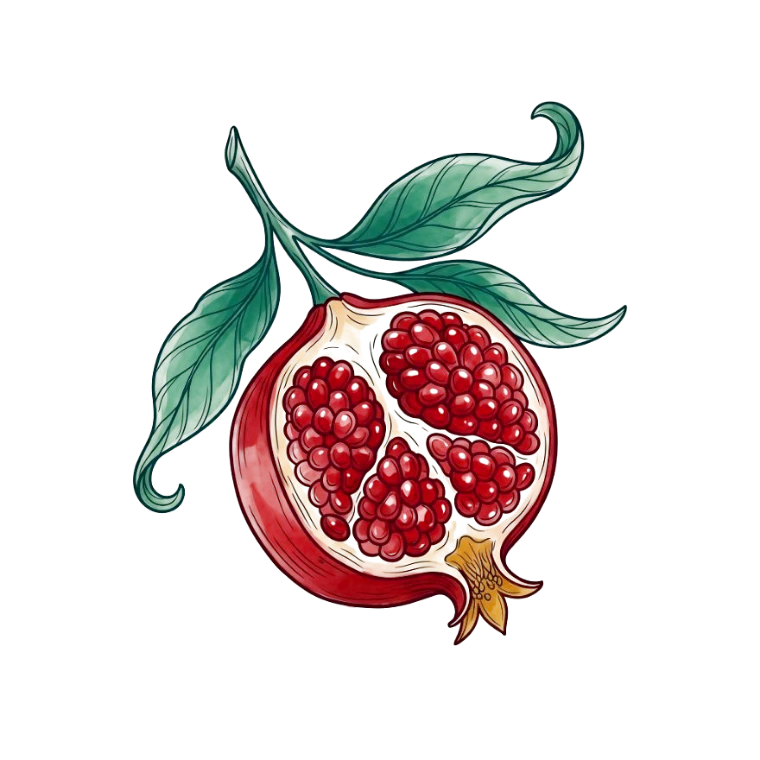
The pomegranate is the symbol of Yalda. its red seeds represent the colours of dawn, the promise that the sun will return. Poetic, right? Now try eating one without ruining every white surface in a three-meter radius.
Eating a pomegranate is not a snack. It is a surgical operation. You extract the دونه (dune, seeds) carefully, ideally into a bowl, sprinkled with گلپر (golpar, angelica powder) and a pinch of salt. Done properly, it goes in a crystal bowl, like a civilized person.
Here in Palermo, I hack at one with a steak knife like a barbarian. The juice hits the wall. Giovanni walks in, sees the red splatter pattern, and leaves. Faster than last time. I think he is genuinely afraid of me now, which, honestly, tracks with how Iranians express affection in general.
فال حافظ (Faal-e Hafez). The Poetry Fortune-Telling
This is the main event. On Yalda Night, you take the دیوان حافظ (Divaan-e Hafez). the collected works of the 14th-century poet Hafez. make a wish, and open the book to a random page. Whatever poem you land on is your fortune for the coming year.
The poem will be about wine, a candle, and a moth. Your aunt will interpret this to mean you are getting married in March. You will interpret this to mean you are failing your midterms. Hafez is just a Rorschach test for Iranian families.
But there is something genuinely beautiful about it. A whole nation, on the darkest night, turning to a poet who has been dead for 700 years and asking him: What is coming next? That is not superstition. That is literature doing what it was always supposed to do.
What People Actually Say on Yalda Night
If you want to participate properly. or at least text your Iranian friend the right thing. here are the phrases people actually use:
- یلدات مبارک! (Yalda-t mobarak!). "Happy Yalda!" The standard greeting. Safe, warm, universally appreciated.
- شب یلداتون به خیر و خوشی (Shab-e Yalda-tun be kheyr o khoshi). "May your Yalda Night be blessed and joyful." Slightly more formal, perfect for older relatives.
- امشب هندونه خوردی؟ (Emshab hendune khordi?). "Did you eat watermelon tonight?" This is how Iranians check if you are observing Yalda properly. The correct answer is always yes.
- فالت چی اومد؟ (Faal-et chi umad?). "What did your Hafez fortune say?" The follow-up question to every Yalda conversation. Be ready for creative interpretations.
Yalda vs. Christmas: The Comparison No One Asked For
Every December, someone. usually a well-meaning colleague or a curious friend. will ask: "Is Yalda like Persian Christmas?"
Here is the honest answer: No. But also, kind of. But mostly no.
Both happen in late December. Both involve family gatherings, special food, and staying up late. Both make you gain weight. But that is where the similarities end.
- Christmas is about the birth of Jesus. Yalda is about the triumph of light over darkness. a Zoroastrian concept that predates Christianity.
- Christmas has gift-giving. Yalda has pomegranates and passive-aggressive poetry readings.
- Christmas has a tree. Yalda has a korsi and a bowl of nuts that tells you how the economy is doing.
- Christmas ends at midnight. Yalda goes until sunrise, because the entire point is to stay awake until the light returns.
Both are beautiful. Both are about warmth and togetherness in the darkest part of the year. But they are not the same thing, and knowing the difference is part of understanding Iran beyond the headlines.
Why Celebrating Yalda Abroad Actually Matters
I know I sound like I am joking about all of this. And I am. partially. I really am shivering in a cold kitchen in Palermo, eating fruit that costs four euros a kilo, pretending I am having a great time.
But here is the thing I did not expect when I moved abroad: if I do not celebrate Shab-e Yalda, I do not feel like myself.
Living abroad. whether you are in Toronto, Berlin, London, or Sicily. means you have to fight to keep these rituals alive. It is easy to just go to sleep at 11 PM on December 21st. It is easy to drink hot chocolate like Giovanni and call it a night.
But we choose the hard way. We choose the expensive watermelon, the confusing poetry, and the pomegranate crime scene on the kitchen counter. We do it because for one night, even if we are alone in a dorm room or a shared apartment with a confused Italian man, we are connected to millions of other Iranians who are also shivering and pretending it is for their health.
That is Yalda. The light always comes back. Even when you are far from home.
So. یلدات مبارک (Yalda-t mobarak). Go eat your watermelon. And if you catch a cold, do not blame me. Blame your ancestors.
For the full map of Iranian holidays and celebrations. from Chaharshanbe Suri's bonfires to Sizdah Bedar's picnics. see the complete Persian holidays guide.
Where to Go Next
Spending Yalda with your partner's Iranian family? The Nowruz and Yalda with your partner's family guide covers exactly what to bring, what to say, and which phrases score points with the in-laws.
For the complete list of Persian blessings and toasts for every occasion. including holidays like Yalda. see the Persian toasts and blessings guide. Now that you know how to survive Yalda Night, here are a few rabbit holes to fall into:
- Why You Sound Like a 19th-Century Poet (And How to Fix It). Learn to speak Farsi like an actual human, not a dusty textbook.
- Farsi Slang Words You Actually Need. The vocabulary your teacher will never give you.
- Why Iranians Want to Die for Their Taxi Drivers. Iranian expressions of love are... intense.
- The Vegetable Insult Guide. Why calling someone a potato is a declaration of war.
- How to Say No in Farsi. A skill you will desperately need at the Yalda table.
If you want the full list of food and drink terms, our Persian food vocabulary guide covers 100+ words with script and transliteration.
And if you want to actually speak this stuff. not just read about it. book a trial lesson with me on Preply. We skip the textbook "سلام، حال شما چطور است؟" and go straight to real Farsi. The kind you need at a Yalda gathering when your aunt asks why you are still single.
Speaking of gatherings, you'll want to know what everything on the table is called. Our Persian food vocabulary guide covers 100+ words every foodie needs.
Get it wrong and the worst that happens is a warm laugh and a story they’ll tell for years. Get it right — refuse the tea twice, accept on the third — and you’ll watch a face open up. You didn’t just speak Persian. You played the game.
A teacher from Tabriz, based in Milano. 5.0 on Preply across 52 reviews, 1,652 lessons taught. He curates the growing dictionary behind this site.
 Persian Culture & TraditionsPersian Names: Meanings, History, and How to Pronounce ThemApr 2026
 Persian Culture & TraditionsMashhad Lawyer Detention: 12 Persian Words for InjusticeDec 2025Persian Culture & TraditionsPersepolis Sandbag Stunt: Why Iran Lost Its Mind (2025)Dec 2025Persian Culture & TraditionsTehrangeles: 6 Bonds Between California and Tehran (2026)Dec 2025Persian Culture & TraditionsIran Cafe Crackdown: The Persian of Coffee Resistance (2026)Dec 2025Persian Culture & TraditionsNarges Mohammadi 2025: Why Tehran Panicked in a GraveyardMar 2026