
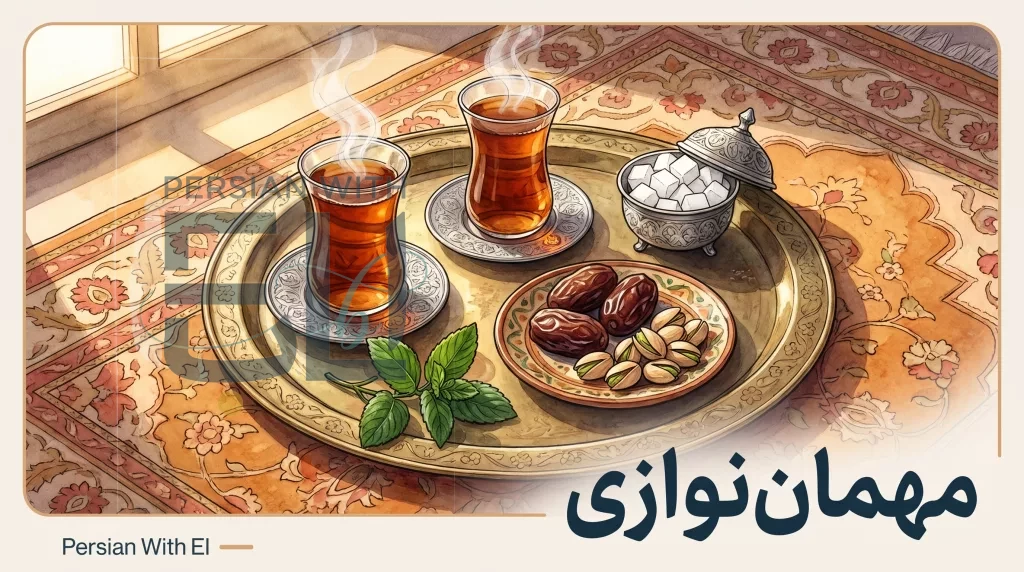
The first time I brought a non-Iranian friend to my parents’ house, she tried to clear her plate after dinner. My mom physically blocked her from reaching the kitchen. "Sit. Down. I’ll bring you tea." My friend looked at me like she’d just been taken hostage. Welcome to Iranian hospitality, where the guest is sacred and the host is relentless.
Iranian hospitality isn’t just "being nice to visitors." It’s a deeply coded social system with specific rules for both the guest and the host. Break the rules and nobody will say anything. Iranians are too polite for that. but follow them, and you’ll earn a level of respect that opens doors to real relationships.
Here’s everything you need to know, from the moment you walk through the door to the elaborate goodbye ritual at the end.
Rule One: Shoes Off at the Door
This is non-negotiable. When you enter an Iranian home, you remove your shoes at the door. The host will usually have دمپایی (dampa’i. slippers) ready for you. Put them on.
Some hosts will say راحت باشید (râhat bâshid. "be comfortable") and tell you to keep your shoes on. This is ta’arof. Take your shoes off anyway. The only exception is a very brief, standing-in-the-doorway visit. and even then, most people slip them off.
The cultural logic: Iranian homes often have carpets. sometimes expensive Persian rugs. and the indoor space is considered clean and separate from the outside world. Tracking street dirt onto someone’s فرش (farsh. carpet) is almost physically painful for an Iranian host to witness.
The Welcome: What You’ll Hear
The moment you step inside, you’ll be hit with a wave of welcoming phrases. Know these and you’ll feel less overwhelmed:
بفرمایید (befarmâyid). This is the Swiss Army knife of Persian hospitality. It means "please," "go ahead," "come in," "sit down," "help yourself," and "after you". all depending on context. When the host says it at the door, they mean "please come in." When they gesture toward the couch, they mean "please sit." When food arrives, they mean "please eat." You’ll hear this word fifty times in one visit.
خوش اومدید (khosh umadid). "Welcome" (literally: "you came well"). The standard greeting when someone arrives. Your response: خوشحال شدم (khoshhâl shodam. "I’m happy") or simply ممنون (mamnun. "thank you").
قدم رنجه کردید (ghadam ranje kardid). "You honored us with your presence" (literally: "you troubled your feet"). This is the formal, extra-polite version. Used more by older Iranians or in formal settings. If someone says this to you, they’re really rolling out the red carpet.
Where to Sit (Yes, This Matters)
Don’t just plop down anywhere. In most Iranian homes, there’s a hierarchy to seating:
- The بالا (bâlâ. upper/head) seat. usually the spot farthest from the door, often a nicer chair or the head of the sofa. is reserved for the most honored guest or the eldest person
- The host will direct you: بفرمایید بشینید (befarmâyid beshinid. “please sit down”) with a gesture toward where they want you
- Don’t argue. Sit where they point. Trying to take a “lesser” seat is polite in theory, but it forces another round of ta’arof that delays everything
If you’re sitting on the floor (which still happens, especially at more traditional homes or during big family gatherings on a سفره (sofre. dining spread on the floor)), don’t point the soles of your feet toward anyone. Tuck your legs to one side or sit cross-legged.
The Tea Ritual
Tea will arrive whether you want it or not. چای (châi. tea) is the backbone of Iranian social life, and refusing it is almost impossible.
The host will pour you a glass of dark red tea in a استکان (estekân. small glass cup, usually waisted) and offer sugar cubes. قند (ghand. sugar cubes). on the side. The traditional method is to hold the sugar cube between your front teeth and sip the tea through it. You don’t have to do this. dropping it into the cup is fine. but if you do the teeth method, you’ll get approving nods.
When the host asks چای میل دارید؟ (châi meyl dârid?. "Would you like tea?"), say yes. Even if you just had three cups. The correct answer is always yes, at least the first time. If you genuinely can’t drink more, say دستتون درد نکنه، سیر شدم (dastetun dard nakone, sir shodam. "bless your hands, I’m full").
The Food: Eat Everything (Then Eat More)
This is where Iranian hospitality becomes a contact sport. The host has been cooking since dawn. The table will have at least three times more food than the number of guests can possibly eat. This is by design.
Your obligations as a guest:
Compliment the food. Say دستت درد نکنه (dastet dard nakone. "may your hand not hurt". the standard compliment for someone who cooked). You can also say خیلی خوشمزهست (kheyli khoshmaze-st. "it’s very delicious"). Mean it. because it probably is.
Accept seconds. The host will pile more food on your plate. They’ll say بفرمایید، بیشتر بخورید (befarmâyid, bishtar bokhorid. "please, eat more"). Refusing once is polite. Refusing three times means you’re actually full. but expect them to try at least twice more after that.
Don’t fill up on rice alone. Iranian meals are built around خورشت (khoresht. stews) and کباب (kabâb. grilled meat). The rice is the base. eat it with the stews. Eating plain rice without touching the khoresht is like going to a concert and only listening to the sound check.
Offer to help clean up (but expect to be refused). After the meal, say کمک کنم؟ (komak konam?. "Can I help?"). The host will say no. نه، بشینید راحت باشید (na, beshinid râhat bâshid. "No, sit down, be comfortable"). Offer once more, then accept the refusal. Insisting too hard can imply the host can’t handle their own kitchen.
Host Rules: The Other Side
If you’re the one hosting Iranians, the expectations flip. Here’s what a good Iranian host does:
Insist guests eat more. The phrase تعارف نکنید (ta’ârof nakonid. "don’t do ta’arof") actually means "stop being polite and eat more." You say this while pushing the rice bowl toward them.
Deflect food compliments. When a guest says the food is delicious, the proper response is نوش جان (nush-e jân. "may it nourish your soul") or قابلی نداشت (qâbeli nadâsht. "it wasn’t worthy"). Never say "thanks, I know". even if you spent 6 hours on that tahdig.
Walk them to the door. and beyond. When guests leave, you don’t wave from the couch. You walk them to the front door. In more traditional settings, you walk them to their car. In very traditional settings, you stand outside and watch until their car disappears. This isn’t excessive. it’s بدرقه (badraqe. seeing off) and it’s a genuine sign of respect.
Offer leftovers. Packing تهدیگ (tahdig. the crispy rice from the bottom of the pot) and extra food for guests to take home is expected. Iranians will literally fight you to take food home. Let them win.
The Goodbye: A Production in Three Acts
Leaving an Iranian home is not a quick process. Budget 20-30 extra minutes for the departure ritual.
Act 1: The announcement. You say دیگه باید بریم (dige bâyad berim. "we should get going"). The host says کجا؟ زوده! (kojâ? zude!. "Where? It’s early!"). even if it’s midnight.
Act 2: The negotiation. You stand up. The host offers more tea. You decline. They offer fruit. You accept one piece to be polite. They bring an entire platter. You eat a few pieces. 15 minutes pass.
Act 3: The escort. You finally make it to the door. Shoes on. The host says بازم بیاید (bâzam biâyid. "come again"). You say حتماً (hatman. "definitely"). Hugs, cheek kisses (same gender or family), and the بدرقه (badraqe) walk to the car.
The whole thing might feel like an elaborate performance, but it’s genuine. The care is real. The food is real. The insistence that you stay longer? That’s real too. If you want to go deeper into how ta’arof shapes all of this. the refusals, the insistence, the social dance. check out my post on how to say no in Farsi.
Common Mistakes Non-Iranians Make
- Taking “no” literally. When an Iranian offers you something and you say no, they’ll offer again. If you say no three times and they stop, they believed you. But the first “no” is almost always ta’arof. they expect you to accept on the second or third offer.
- Not bringing a gift. Always bring something. شیرینی (shirini. pastries), گل (gol. flowers), میوه (mive. fruit). Read more in my Iranian gift-giving guide.
- Leaving too abruptly. A quick “bye, gotta go” feels cold. Ease into the departure. Compliment the evening. Thank the host multiple times.
- Refusing food too firmly. “I’m on a diet” won’t save you. “I already ate” is slightly better but still weak. The path of least resistance: eat a small portion and praise it heavily.
If phrases like بفرمایید (befarmâyid) and نوش جان (nush-e jân) feel overwhelming right now, ZabanYar. the app I’m developing. is specifically designed to teach this kind of situational Farsi, the stuff that matters in real Iranian homes, not just in classrooms.
Why It Matters Beyond Politeness
Iranian hospitality isn’t just etiquette. it’s identity. The concept of مهماننوازی (mehmân-navâzi. literally "guest-cherishing") goes back thousands of years in Persian culture. In pre-Islamic Iran, refusing hospitality to a traveler was considered a sin. That DNA is still alive.
When an Iranian grandmother forces a fourth serving of قورمه سبزی (ghorme sabzi. herb stew) onto your plate, she’s not just feeding you. She’s performing an act of cultural identity that connects her to generations of Persians who believed that how you treat a guest defines who you are.
Understanding this changes how you experience Iranian social life. And if you want to see how humor fits into all of these social dynamics, read about Persian jokes and Farsi humor. because Iranians can (and will) make fun of every single rule I just listed.
FAQ
What does “befarmâyid” mean in Iranian hospitality?
Should I take my shoes off in an Iranian home?
How do you say “welcome” in Farsi?
Is it rude to refuse food at an Iranian dinner?
What is “mehmân-navâzi” in Persian culture?
If you want to learn the hospitality phrases in this post properly. pronunciation, context, and all. I teach one-on-one Farsi lessons on Preply. We practice real conversational situations, not textbook dialogues where everyone speaks like a robot.
Master the language of Iranian hospitality. ZabanYar helps you practice taarof phrases and social vocabulary with AI-powered conversation drills.
This post is part of our Iranian Social Customs, Humor & Internet Culture guide. For more on the phrases you’ll hear in these situations, see why “I” sounds arrogant in Farsi and our guide to Iranian death expressions as love language.