
Persian Tea Ceremony: Not a Recipe, a Language Lesson
The Persian Tea Ceremony Isn't About Tea. It's About What You Say While Drinking It
I need to correct something: calling this a persian tea ceremony is misleading. Iran doesn't have a tea ceremony the way Japan does: precise, silent, choreographed. Iran has a tea culture, and the culture part is 90% language. It's the phrases you say when you pour, the refusals you perform when someone offers, the compliments about the color of the brew. The tea itself is almost secondary. Almost.
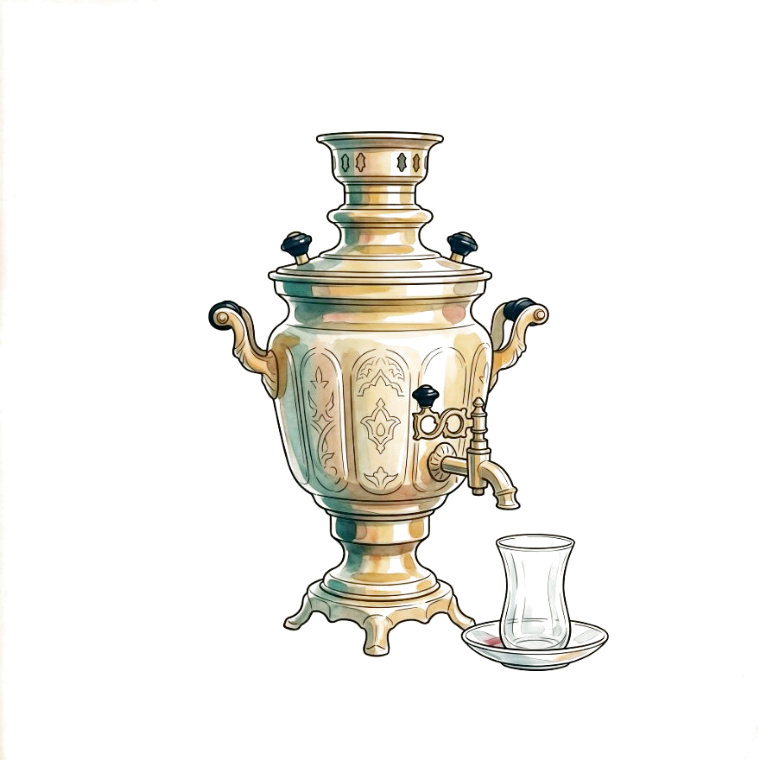
If you spend a single afternoon in an Iranian home, you'll drink a minimum of four glasses of chai (چای). Not cups, glasses. Iranians drink tea from small, waisted glasses called estekaan (استکان) that show off the color of the tea. The color matters. Too light means it hasn't brewed long enough. Too dark means the host messed up. A perfect ruby-amber glow means tazeh dam-e (تازه دمه): it's freshly brewed, and that's a compliment worth giving.
This episode is a language lesson wearing a tea guide's clothing. By the end, you'll know the vocabulary of every object on an Iranian tea tray, the verbs for brewing and pouring, and, most importantly, the tarof phrases that make Iranian tea culture what it really is.
The Setup: Samovar, Estekaan, and Everything on the Tray
Before we get to phrases, you need to know what's on the table. Iranian tea service has specific items, and each one has a word you'll hear constantly.
| Farsi Script | Transliteration | English | Note |
|---|---|---|---|
| سماور | samaavar | Samovar | From Russian: the large water heater. Traditional ones are charcoal-powered. |
| قوری | qoori | Teapot | Sits on top of the samovar. This is where the tea brews. |
| استکان | estekaan | Tea glass | Small, waisted, transparent: shows the tea color. |
| نعلبکی | na'lbeki | Saucer | Goes under the estekaan. Some people pour tea into it to cool. |
| قندان | qandaan | Sugar bowl | Holds sugar cubes (qand). |
| قند | qand | Sugar cube | Not in the tea, between your teeth. More on this below. |
| نبات | nabaat | Rock candy / saffron candy | The yellow crystallized sugar stick. Dissolves in the tea. |
| سینی | sini | Tray | Everything arrives on a sini. |
The word qandaan is a perfect example of Farsi's suffix system: qand (sugar) + -aan/-daan (container for). You'll see this pattern everywhere: namak-daan (salt shaker), gol-daan (flower vase, literally "flower container"), zir-sigaari (ashtray). Once you see the pattern, you can almost guess words you've never heard before.
Brewing Tea: Dam Kardan (دم کردن)
The most important verb in this entire episode is dam kardan (دم کردن), to brew, to steep. You saw it briefly in the bastani episode for steeping saffron. In tea culture, it's the main verb, and Iranians use it with precision.
چای رو دم کردم.
Chaai ro dam kardam.
I brewed the tea.
چای دم کشیده.
Chaai dam keshideh.
The tea has steeped (it's ready).
چای تازه دمه.
Chaai taazeh dam-e.
The tea is freshly brewed.
That last phrase, taazeh dam-e, is both a statement and a subtle flex. It means "I just made this fresh, especially for you." It's hospitality compressed into two words.
The actual brewing process in Farsi:
Step 1:
آب رو بذار بجوشه.
Aab ro bezaar bejoosheh.
Let the water boil.
Step 2:
چای خشک رو بریز توی قوری.
Chaai-e khoshk ro beriz tuye qoori.
Put the dry tea into the teapot.
Step 3:
آب جوش بریز روی چای.
Aab-e joosh beriz ruye chaai.
Pour boiling water over the tea.
Step 4:
بذار دم بکشه. حداقل ده دقیقه.
Bezaar dam bekesheh, hadde-aghal dah daqiqeh.
Let it steep, at least ten minutes.
Step 5:
چای رو بریز توی استکان. نصف چای، نصف آب جوش.
Chaai ro beriz tuye estekaan: nesf chaai, nesf aab-e joosh.
Pour the tea into the glass: half tea concentrate, half boiling water.
That last step is key. Iranian tea is brewed strong (a dark concentrate) and then diluted with hot water to the drinker's preference. Some people like it por-rang (پُررنگ), dark, strong. Others want it kam-rang (کمرنگ), light, weak. Knowing your preference and stating it is part of the social ritual.
The Phrases That Matter More Than the Tea
Here's where the real language lesson lives. Iranian tea culture runs on a specific set of phrases: offers, refusals, compliments, insistences. If you've read my piece on saying no in Farsi, you already know that Iranians don't take "no" at face value. Tea is where this plays out most intensely.
The Offer
!بفرمایید چای
Befarmaaeed chaai!
Please, have some tea!
Befarmaaeed (بفرمایید) is the Swiss Army knife of Farsi politeness. It means "please" in the sense of "please, go ahead, help yourself, take a seat, come in." You'll hear it fifty times a day in Iran. At the tea table, it specifically means: "I'm offering you tea and you will accept because refusing would be rude, but you're going to refuse anyway, and then I'll insist, and then you'll accept, and this is all perfectly normal."
The Refusal (That Isn't Really a Refusal)
.ممنون، زحمت نکشید
Mamnoon, zahmat nakeshid.
Thank you, you shouldn't have bothered.
.دستتون درد نکنه، من تازه خوردم
Dastetoon dard nakoneh, man taazeh khordam.
Thank you (lit, may your hand not hurt), I just had some.
Both of these are polite first-round refusals. Nobody takes them seriously. The host will pour anyway. You'll drink the tea. This dance has happened a billion times across Iran and it's not stopping for you.
The Insistence
!تعارف نکنید، بخورید
Ta'arof nakonid, bekhorid!
Don't do tarof, drink!
.تازه دمه، الان از دم در بیاد خوشمزهتره
Taazeh dam-e, alaan az dam dar biyaad khoshmazeh-tar-e.
It's freshly brewed, it's tastier when it just comes out of the steep.
The Compliment
.چایتون خیلی خوشرنگه
Chaai-etoon kheli khosh-rang-e.
Your tea has a beautiful color.
.دست شما درد نکنه، عالی دم کردید
Dast-e shomaa dard nakoneh, aali dam kardid.
May your hand not hurt, you brewed it excellently.
Complimenting the color of someone's tea is a genuine social skill in Iran. It shows you know what good tea looks like and that you appreciate the host's effort. It's a small thing that carries weight.
Qand: The Sugar Cube Between Your Teeth
This is the part that fascinates everyone. Traditional Iranian tea drinking involves placing a qand (قند), a sugar cube, between your front teeth and sipping the hot tea through it. The sugar dissolves slowly, sweetening each sip differently. It's an acquired skill. Your first attempt, you'll probably just swallow the sugar cube whole or burn your lip. Keep trying.
The technique has a name: qand pahlu (قند پهلو), literally "sugar on the side." The alternative is nabaat, saffron rock candy that you drop into the tea glass and let dissolve. Some people use both. Some use neither. It's personal.
Useful phrases:
قند میخوای یا نبات؟
Qand mikhay yaa nabaat?
Do you want sugar cubes or rock candy?
.من بدون قند میخورم
Man bedun-e qand mikhoram.
I drink it without sugar.
Tea Verbs: The Complete Set
| Farsi Script | Transliteration | English | Usage Note |
|---|---|---|---|
| دم کردن | dam kardan | to brew / steep | THE tea verb (also used for saffron, herbs) |
| ریز کردن | riz kardan | to pour (carefully) | Pouring tea into small glasses requires precision |
| جا افتادن | jaa oftaadan | to steep properly / to settle | When the tea has fully developed its flavor |
| نوشیدن | nooshidan | to drink (formal) | Literary: you'll see it in writing more than speech |
| خوردن | khordan | to drink / eat | In spoken Farsi, you "eat" tea: chaai mikhoram |
| سرد شدن | sard shodan | to cool down | "Chaai-at sard shod" = your tea got cold (a tragedy) |
The verb jaa oftaadan (جا افتادن) is wonderful. Literally it means "to fall into place." For tea, it means the brew has settled and developed its full flavor. But in everyday Farsi, you use it for anything that's clicked or settled: a new city you've adjusted to, a skill that's become second nature, an idea that's finally made sense. "Milan baraam jaa oftaadeh". Milan has settled for me, I've adjusted. One verb, learned over tea, applicable everywhere.
The Samovar: More Than a Water Heater
The samovar (سماور) came to Iran from Russia in the 19th century, along with the tea habit itself. Before that, Iranians drank coffee, qahveh (قهوه). The word "coffee" actually comes from the Arabic/Persian qahveh. So Iran gave the world the word for coffee and then switched to tea. Typical.
Traditional samovars are charcoal-powered brass giants that sit in the center of the room. Modern Iranian homes use electric samovars, which are essentially fancy kettles with a teapot on top. But in villages and at family gatherings, the old charcoal samovar still makes appearances, and the tea it produces, flavored slightly by the charcoal smoke, is genuinely different.
The ritual of the samovar is communal. It stays on all day. Anyone can walk up and pour themselves a glass. In Iranian offices, there's always a samovar somewhere. In carpet shops, the first thing you're offered is chai from the samovar. It's the social infrastructure of Iranian life, and it's been that way for over a century.
One More Glass: Yek Estekaan-e Digar
The phrase that defines Iranian tea culture:
یه استکان دیگه بخورید.
Ye estekaan-e digeh bekhorid.
Have one more glass.
You will hear this after every glass. Doesn't matter if you've had seven. The offer of one more glass is automatic, reflexive, and deeply sincere. And the correct response, at least for the first two refusals, is:
.نه ممنون، سیر شدم
Na mamnoon, sir shodam.
No thanks, I'm full.
But you'll drink it anyway. Because that's how it works. And because the tea is good, and the company is better, and you're learning Farsi without even trying.
If you want a full scene of this tea-and-tarof dance in action, I wrote an entire Scene episode about it, with the full back-and-forth dialogue you'd hear in a real Iranian living room.
Kitchen and Tea Vocabulary Recap
| Farsi Script | Transliteration | English |
|---|---|---|
| چای | chaai | Tea |
| چای سبز | chaai-e sabz | Green tea |
| چای سیاه | chaai-e siyaah | Black tea |
| پُررنگ | por-rang | Strong/dark (tea) |
| کمرنگ | kam-rang | Weak/light (tea) |
| داغ | daagh | Hot |
| ولرم | velarm | Lukewarm |
| تلخ | talkh | Bitter |
| شیرین | shirin | Sweet |
FAQs
What kind of tea do Iranians drink?
Why do Iranians use small glasses instead of mugs?
What is the sugar cube between the teeth technique?
How many cups of tea do Iranians drink per day?
Is the Iranian tea ceremony similar to the Japanese tea ceremony?
Tea in Iran isn't a beverage. It's a conversation starter, a hospitality ritual, and, if you've been paying attention, a Farsi lesson that teaches you compound verbs, politeness phrases, and the entire tarof system in one sitting. All from a glass of black tea.
Our app, ZabanYar, is coming soon.
If the tarof phrases in this episode intrigued you and you want to actually practice them with a native speaker who'll push back the way a real Iranian host would, let's do a session on Preply. I'll bring the tea vocabulary, you bring the willingness to be wrong.
Get it wrong and the worst that happens is a warm laugh and a story they’ll tell for years. Get it right — refuse the tea twice, accept on the third — and you’ll watch a face open up. You didn’t just speak Persian. You played the game.
A teacher from Tabriz, based in Milano. 5.0 on Preply across 52 reviews, 1,652 lessons taught. He curates the growing dictionary behind this site.
 Persian Culture & TraditionsStop Saying 'No' Like a Robot: 7 Persian Polite RefusalsNov 2025
 Persian Culture & TraditionsKitchen Farsi: The Language Your Parents Speak at HomeMay 2026Persian Culture & TraditionsHafez and the Art of Not Caring in FarsiAug 2026
 Persian Culture & TraditionsFarsi Slang: Khafan, Oskol and 8 More Words, With MeaningsNov 2025Persian Culture & TraditionsIran Internet Censorship: 4 Persian Words That Define ItDec 2025Persian Culture & TraditionsFaloodeh and Bastani: Persian Ice and SaffronApr 2026