
خیرات
kheyrat is charitable giving as a culture: the Ashura nazri, the Ramadan iftar food handed at the gate, the everyday gestures distinct from zakat and sadaqe.
kheyrat is charitable giving as a culture: the Ashura nazri, the Ramadan iftar food handed at the gate, the everyday gestures distinct from zakat and sadaqe.
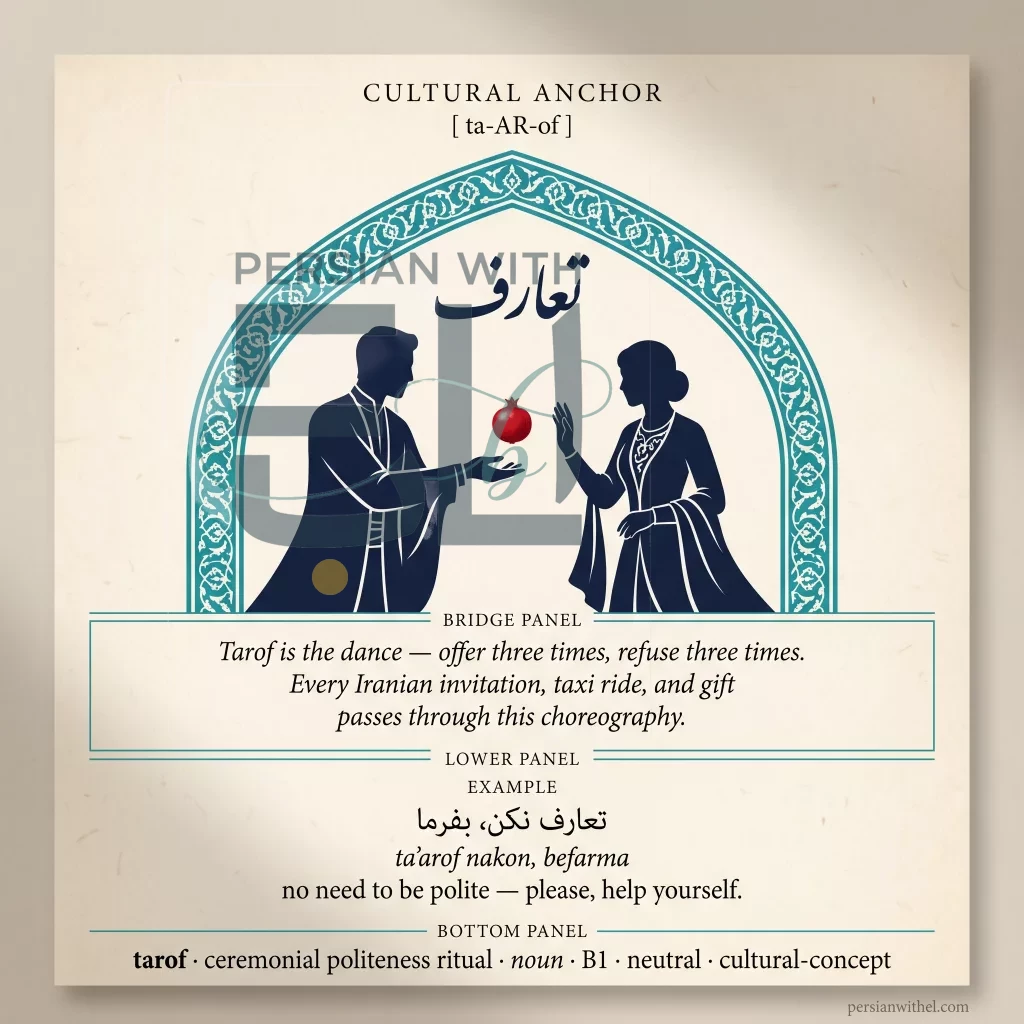
tarof-bashi is the family member or friend who taarofs hardest at gatherings, the master of ritual courtesy, often used with affection.
tasbih-khani is the practice of dhikr on prayer beads: 33 or 99 repetitions of a sacred phrase, common in Ramadan, at funerals, and in private devotion.
nalbaki is the small saucer that goes under the estekan tea glass, the half of the pair that holds the sugar cube and catches the spill.
estekan is the small Iranian tea glass: clear, narrow-waisted, designed to show the color of strong black tea against the light.
samavar is the Russian-origin tea heater that anchors every Iranian gathering: brass or copper or electric, always with a teapot on top.
manghal is the Iranian charcoal brazier: the kebab grill at the restaurant, the warmer under the korsi blanket, the bowl of glowing coals in winter.
termeh is the silk paisley fabric of Yazd, used as a table cover, a sofreh-e haft-sin, and the ceremonial gift-wrap of Iranian formal life.
qalicheh is the small Persian rug, the runner or prayer-rug size, the rug you actually walk on between bigger qalis.
qali is the Persian rug, a knotted-pile carpet woven across Iran for more than two thousand years and central to Iranian identity and craft.