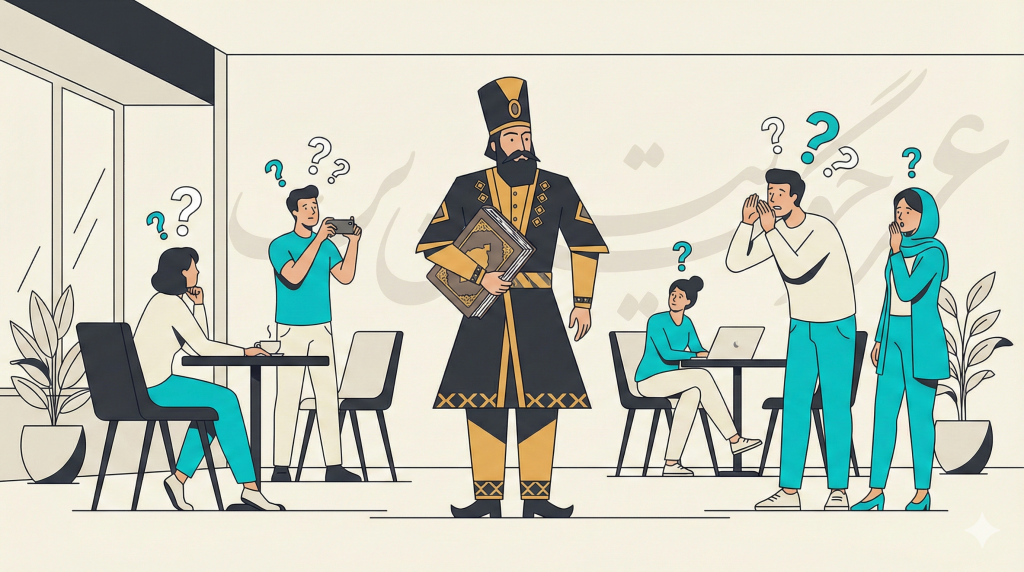
I am sitting in a cafe in Porta Ticinese. It is one of those grey Milan mornings where the rain feels personal. I just paid three euros for an espresso, which is technically a war crime against my student budget, but at least nobody is shutting the place down because the barista forgot to wear a headscarf.
Meanwhile, in Tehran, the Iran cafe culture crackdown is alive and thriving. The morality police are not inspecting milk temperatures. They are waging a slow, grinding war on the last free social spaces young Iranians have. And if you want to understand Iranian society. not from a textbook, but from the street. you need to understand what a cafe means in Iran, what happens when it gets sealed, and why the vocabulary around it tells you more than any BBC headline.
The Cafe is the Only Room Where Iranians Can Breathe
Let me explain something that most language learners miss. When you study Farsi from a book, you learn polite, structured, formal Persian. You learn how to say “Lotfan yek chāi befarestid” (لطفاً یک چای بفرستید). please send one tea. That is lovely. That is also not how anyone talks in a ghahve-khune (قهوهخونه), which literally means “coffee house” (a tradition with deep roots in Iranian social life), or in a modern Tehran cafe.
In real life, you hear: “Dāsh, yeki bezar” (داش، یکی بزر). “Bro, put one down.” No please. No verb conjugation ceremony. Just vibes. If you have been learning Farsi and you sound like a 19th-century poet when you order coffee, this is your sign to fix that.
The cafe in Iran is not a luxury. It is a pātogh (پاتوق). A pātogh is your base. Your headquarters. The place where everybody knows your name, your order, and which ex you are avoiding. For young Iranians. students, artists, freelancers. the cafe is the one place where you can sit with friends, laugh too loud, study for your konkur entrance exam, flirt with someone across the table, and pretend for ninety minutes that you are living in a normal country.
That is why the government hates it.
The “Nofouz” Fantasy: Why Hardliners Think Your Latte is a Revolution
Here is the logic, if you can call it that. The hardliners. the guys in Parliament who believe fun is a Western bioweapon. have decided that cafes are the front line of a “Jange Narm” (جنگ نرم), a “Soft War.” In their heads, every cafe with dim lighting and jazz music is a Trojan horse for Western infiltration.
They call it nofouz (نفوذ). Literally, “infiltration.” It is their favorite conspiracy theory. Western culture is not just influencing young Iranians. It is infiltrating them. Like a virus. Like an operation. And if you let a boy and a girl sit at the same table with cappuccino foam and lo-fi beats, the entire Islamic Republic will collapse.
So they close the cafes.
I wish I were exaggerating. But this is the actual framework. And the vocabulary tells you everything. When a regime describes social life as “infiltration,” it is telling you that it sees its own citizens as enemy territory. That is not a political metaphor. That is a confession.
What Happens When “Amāken” Crashes Your Evening
So, what does a raid actually look like?
You are sitting there. Maybe you are sipping a saffron tea. Maybe your friend is showing you a meme on their phone. Then a white van pulls up outside. The energy in the room shifts like someone flipped a switch.
It is the Amāken (اماکن).
Amāken is the “Public Places Police.” They are the buzzkill squad. Their entire job is to march into cafes, restaurants, and social spaces and look for anything “un-Islamic.” Is that woman’s headscarf too loose? Is the music too Western? Are those two people sitting too close? Is the lighting too. and I am not making this up. romantic?
If they find something, or even if they just do not like the vibe, they hit the owner with a charge of hanjār-shekani (هنجارشکنی). “norm-breaking.” Basically, the crime of existing while cool. The crime of running a business where people are happy.
And if the violation is serious enough? They do not just fine you. They polomb (پلمب) you.
The “Polomb”: A Sticker That Kills a Business
Polomb means “sealed.” When Amāken decides a cafe is guilty of hanjār-shekani, they put an official seal across the door and shut it down. Done. Your cafe, your livelihood, your customers. gone. Sealed by a sticker.
Walk through Tehran today and you will see polomb banners everywhere. Trendy cafes with exposed brick walls. Bookshop-cafes that sold poetry alongside pour-overs. Small restaurants where the owner spent their life savings on renovation. All sealed. All dead.
It is tragic, but it is also absurd. The government genuinely thinks that if they close enough cafes, young people will suddenly decide to go pray at the mosque instead. Spoiler: they will not. They never do. They will just find a new underground pātogh. That is how it has always worked. That is how it will always work.
The Vocabulary of Resistance: 6 Persian Words You Need
If you want to speak about Iran cafe culture like a local. not like a textbook. here are the words from this story that you actually need to know. And yes, these are the kinds of words that belong in your Farsi slang survival kit.
1. Pātogh (پاتوق). Hangout Base
What it means: Your regular spot. Your social headquarters.
Street vibe: The place where the waiter already knows you want no sugar.
Example: “Un cafe naro, pātogh-e basijia shode.”
اون کافه نرو، پاتوق بسیجیا شده.
(Do not go to that cafe. It has become a hangout for Basijis.)
2. Hanjār-shekani (هنجارشکنی). Norm-Breaking
What it means: Breaking social or Islamic norms. The government uses it seriously. Young people use it ironically.
Street vibe: Doing something cool that the regime would hate.
Example: “Dishab yeki hanjār-shekani kardim o tu pārk āhang-e boland gozāshtim.”
دیشب یکم هنجارشکنی کردیم و تو پارک آهنگ بلند گذاشتیم.
(Last night we did some norm-breaking and played loud music in the park.)
3. Polomb (پلمب). Sealed by Authorities
What it means: Officially sealed and shut down.
Street vibe: A business death sentence.
Example: “Shenidi? Sām Cafe polomb shod chon gārsunesh rusari nadāsht.”
شنیدی؟ سام کافه پلمب شد چون گارسونش روسری نداشت.
(Did you hear? Sam Cafe got sealed because the waitress had no scarf.)
4. Nofouz (نفوذ). Western Infiltration
What it means: Infiltration. Influence. The regime’s favorite boogeyman.
Street vibe: A conspiracy theory word used to blame everything on the West.
Example: “Bābām fekr mikone tātu-ye man neshune-ye nofouz-e gharbie.”
بابام فکر میکنه تاتوی من نشونه نفوذ غربیه.
(My dad thinks my tattoo is a sign of Western infiltration.)
5. Amāken (اماکن). Public Places Police
What it means: The bureau that polices public spaces.
Street vibe: The fun police. The people who ruin everything.
Example: “Pāsurā ro ghāyem kon! Amāken dāre miyād.”
پاسورهها رو قایم کن! اماکن داره میاد.
(Hide the cards! Amāken is coming.)
6. Jange Narm (جنگ نرم). Soft War
What it means: The regime’s term for cultural warfare waged by the West.
Street vibe: The framework that justifies cracking down on anything fun or modern.
Example: “Sedā o simā goft kāfe-hā jebhe-ye jange narm-e.”
صدا و سیما گفت کافهها جبهه جنگ نرمه.
(State TV said cafes are the front line of the Soft War.)
Why This Matters If You Are Learning Farsi
Here is the thing most Farsi learners do not realize. The language you need to understand Iranian daily life is not the language you will find in most courses. It is not the formal, carefully polished Persian that makes you sound impressive in a classroom. It is the raw, street-level vocabulary that people actually use when they are talking about their lives. their pātogh getting raided, their friend’s cafe getting polombed, the Amāken showing up uninvited.
When Iranians talk about these things, they do not speak in the clean, composed language of diplomacy. They speak with the emotional, exaggerated, hyperbolic Persian that is the actual heartbeat of the language. They say “Hame chiz ro kharāb kardan” (همه چیز رو خراب کردن). they ruined everything. Not “they implemented restrictive measures.” Ruined. Everything.
If you want to understand Iran, you need to understand the cafe. And if you want to understand the cafe, you need the vocabulary that lives inside it. not above it.
That is what I try to teach. Not textbook Farsi. The real thing. The Farsi that is spoken in cafes that might not exist tomorrow. And look. understanding how to say no in Farsi without causing an international incident is part of the same street-level fluency. It is all connected.
For the complete tea vocabulary. from samovar to sugar cubes. see our Persian tea vocabulary guide.
The Cafes Will Not Disappear
I want to end on something honest. The regime has been trying to control social spaces in Iran for over forty years. They have closed ghahve-khune-hā. They have sealed cafes. They have fined restaurants. They have arrested DJs, baristas, and business owners whose only crime was creating a space where people felt free.
And yet. the cafes keep coming back. The pātogh-hā keep multiplying. Because you cannot seal a generation’s need to sit together, drink something warm, and be human for an hour.
They will never win this one. And the kids know it.
If you want to learn the kind of Farsi that actually lives inside these conversations. street Farsi, not museum Farsi. book a session with me on Preply and I will teach you the language the way it is actually spoken. From the cafe. From the street. From the real Iran.
If the cafe menu has you lost, brush up with our Persian food vocabulary. Knowing your doogh from your sharbat helps more than you’d think.