I’m at Cadorna station in Milan, five bars of 5G, recording a voice note for my mom in Tehran. The message sends instantly. Then I switch to my friend Sahar. Spinning wheel. Grey clock. Nothing.
My connection is fine. The problem is on the other end. the Iranian government just throttled the internet. Again.
If you want to understand Iran internet censorship in 2026, don’t read policy papers (though Freedom House’s Iran internet freedom report is worth bookmarking). Look at the phone of a 22-year-old in Tehran. It’s not a communication device. It’s a battlefield. And the vocabulary of that battle. فیلترشکن (filtershekan), کانفیگ (config), اینترنت ملی (internet-e melli). tells you more about daily life in Iran than any news headline.
Filtershekan: The Word Every Iranian Grandma Knows
In Europe, a VPN is what you use to watch American Netflix or dodge targeted ads. In Iran, a فیلترشکن (filtershekan). literally “filter-breaker”. is oxygen.
It’s the first app you install on a new phone. Before contacts. Before WhatsApp. Before anything. Because without a filtershekan, your expensive Samsung is a calculator that can also take photos. Instagram? Filtered. YouTube? Filtered. Twitter, Telegram’s public channels, most of the internet that makes the internet worth having? All filtered.
This isn’t hacker terminology. Your māmāni (grandma) uses this word. She calls you when hers stops working: “filtershekan-am vasl nemishe, che konam?” (فیلترشکنم وصل نمیشه، چه کنم؟). “My filtershekan won’t connect, what do I do?”
And the answer changes every week, because the government’s censorship infrastructure is in a constant arms race with the people trying to get around it. OONI’s Iran network measurement data tracks the blocks in real time. The app that worked on Tuesday is dead by Friday. You try a different protocol. That dies too. The cycle never ends.
Configs: The New Black Market Currency
Here’s where it gets surreal. The old-school “download an app, press connect” era of VPNs is over in Iran. The government got too good at identifying and blocking commercial VPN traffic. So people adapted.
Now everyone in Iran is an amateur network engineer. You don’t just “turn on” the internet. You load a کانفیگ (config). a string of encrypted code that tells your phone how to tunnel through the censorship wall to a specific server abroad. These configs use protocols with names like V2Ray, VLESS, and Xray. tools that were built by developers specifically for circumventing state censorship.
This has created an actual underground economy. People sell working configs on Telegram the way they used to sell pirated DVDs in the 2000s. Everyone has their “config guy.” He sends you a QR code, you scan it, and suddenly you have a German IP address. Freedom. for about 48 hours, until the censors identify the server and block it.
Then the Telegram messages start flying: “ye config-e jadid befrest, in server-e Almān morde” (یه کانفیگ جدید بفرست، این سرور آلمان مرده). “Send a new config, the German server is dead.”
Buy, connect, get blocked, repeat. That’s the rhythm of internet access in Iran.
Internet-e Melli: The Luxury Prison
The government’s official answer to all this is اینترنت ملی (internet-e melli). the “National Internet,” formally known as the National Information Network.
On paper, it sounds reasonable: a domestic network that’s fast, secure, and doesn’t depend on international bandwidth. In practice, it’s a walled garden where the walls are ten meters high and topped with razor wire.
Internet-e melli loads government banking sites instantly. It streams domestic movies fine. But it can’t reach YouTube, Google, or anything hosted outside Iran. which is, you know, most of the internet. It’s like being told your city has great roads, but they only go to three places.
The strategy is obvious: make the filtered internet so slow and unreliable that the “national” alternative looks attractive by comparison. Give people just enough domestic connectivity that they can do banking and watch state TV, but cut them off from the global conversation.
Young Iranians see right through it. “Internet-e melli yani zendān-e lākcheri”. “National internet means luxury prison.” It’s become a running joke, the kind of gallows humour that Iranians are famous for.
Ekhtelāl: The Word That Means “We Know You Know”
When the government deliberately slows or disrupts internet access. which happens during protests, elections, or sensitive political moments. the official term is اختلال (ekhtelāl), meaning “disruption” or “disturbance.”
It’s a beautifully dishonest word. State media will report: “ekhtelāl dar shabake-ye internet”. “disruption in the internet network”. as if it’s a technical glitch. As if a cable was accidentally unplugged. Everyone knows it’s deliberate. The government knows everyone knows. And they still use the word.
The same censorship infrastructure was used during the arrest of Nobel laureate Narges Mohammadi and other political events. During the 2022 Mahsa Amini protests, ekhtelāl meant something much more severe: near-total internet shutdowns lasting weeks. Mobile data killed entirely. Home broadband throttled to speeds that made loading a webpage a five-minute exercise in patience. Reporters Without Borders’ Iran profile documents how these shutdowns silence dissent.
The economic cost is staggering. Iranian businesses that depend on international communication. freelancers, exporters, tech startups. lose money every time there’s an ekhtelāl. But the political calculation is simple: controlling information flow is worth more than economic damage.
How Iranians Talk About This
What’s fascinating for language learners is how censorship has reshaped everyday Persian. These aren’t technical terms reserved for IT people. They’re dinner table conversation:
- “Filtershekan-et kār mikone?” (فیلترشکنت کار میکنه؟). “Is your filtershekan working?”. The new “How are you?”
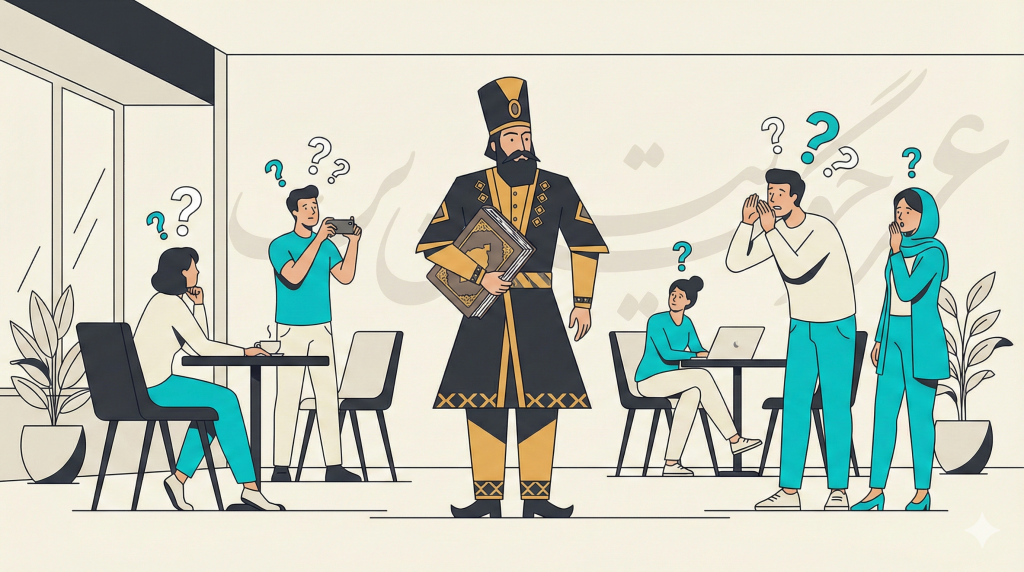
- “Config dāri?” (کانفیگ داری؟). “Do you have a config?”. Asked at cafes the way people ask for the WiFi password
- “Net ghaat shod” (نت قطع شد). “The internet got cut”. Said with the same resignation as “it’s raining”
- “Sorat-e net emrooz afsordegi gereft” (سرعت نت امروز افسردگی گرفت). “The internet speed got depressed today”. Classic Iranian dark humour
If you’re learning Persian, knowing these phrases does something textbooks can’t: it makes you sound like someone who understands what life is actually like in Iran, not just someone who memorised greetings.
The full digital vocabulary: tech words in Persian covers 38 terms from devices to VPN culture.
The Daily Battle, Summarised
Here’s a typical evening for a university student in Tehran in 2026:
- Open phone. Filtershekan is dead. Try a different protocol.
- Ask roommate for a new config. Scan the QR code.
- Connected. barely. Instagram loads at dial-up speed.
- Professor uploads lecture notes to Google Drive. Google Drive is filtered. Need a working filtershekan.
- Current config dies mid-download. Start over.
- Give up. Use internet-e melli to check bank balance. At least that works.
- Government announces another ekhtelāl for the weekend. No reason given.
This is the loop. Millions of people, every day, burning hours just to access what the rest of the world takes for granted.
Why This Matters for Understanding Iran
Language doesn’t exist in a vacuum. If you learn how Iranians actually speak. not textbook Farsi, but the real thing. you’ll keep running into these words. They’re embedded in daily conversation the way “traffic” and “weather” are in English small talk.
Understanding filtershekan, config, internet-e melli, and ekhtelāl doesn’t just expand your vocabulary. It gives you context for why your Iranian friend takes 20 minutes to reply on WhatsApp, why voice notes are preferred over video calls (lower bandwidth), and why Telegram. despite being partially filtered. remains the communication backbone of an entire country.
The pollution in Tehran is visible. The censorship is invisible but just as suffocating. Both shape the language people use every day.
And if you drop a casual “filtershekan-et vasi nemishe?” into a conversation with an Iranian, you’ll get a reaction that no textbook phrase ever could. because you just acknowledged the thing everyone lives with but nobody outside Iran talks about.
Want to learn the Persian that Iranians actually speak?
Book a lesson with me on Preply. we’ll cover the real vocabulary, not the textbook version.
Ready to start? Our guide to learning Farsi online breaks down the best digital tools and strategies.