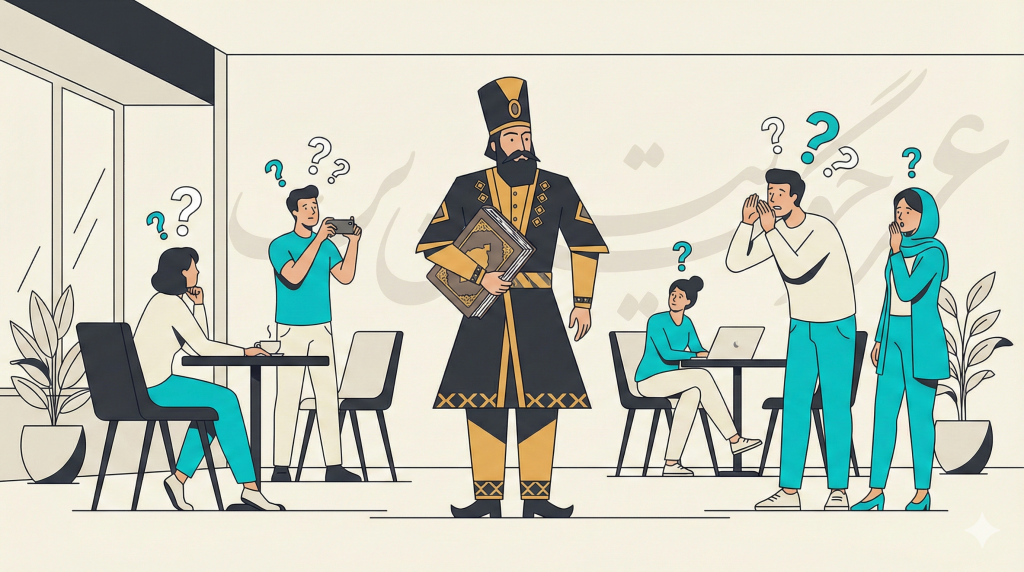
Stop memorizing polite greetings. No one in Tehran cares if you can say “The weather is pleasant.”
If you really want to understand Persian street culture, you need to understand the grocery store. We don’t just insult people with curse words. we use produce. It’s passive-aggressive, it’s confusing for foreigners, and it is absolutely hilarious.
This is the side of Farsi your textbook will never teach you. Linguists studying humor in Persian culture have long noted how Iranians weaponize everyday objects in conversation. If you’ve ever wondered why you sound like a 19th-century poet instead of a real person, vegetable insults are your crash course in how Iranians actually talk.
Here in Messina, if a guy cuts me off in traffic, he screams “Che cazzo!” and invokes the saints. In Tehran? We just call him a Pear. It cuts deeper because it attacks his coordination, not his mother.
Here is the hierarchy of Persian vegetable insults, ranked by how much psychological damage they do.
1. The “Sib-zamini” (Potato). سیبزمینی
Severity: High
You might think calling someone a “Potato” implies they are lazy or overweight. You are wrong.
In Iran, being a Sib-zamini (سیبزمینی) means you are soulless. You are Bi-rag (بیرگ). literally “veinless.” It means you have no jealousy, no honor, and no reaction. You are emotionally flatlined. A potato sitting on the counter while the kitchen burns down around it.
If someone hits on your girlfriend and you just stand there? You are a Sib-zamini.
If the country is falling apart and you are just scrolling Instagram? Sib-zamini.
If your friend insults your mother and you shrug? Sib-zamini. and at that point, your friendship might be over.
It is the ultimate insult for indifference. In Italian politics, indifference might be a strategy. In an Iranian relationship? It’s a death sentence. Iranians expect passion, reactions, heat. A potato gives you none of that.
2. The “Hendooneh” (Watermelon). هندوانه
Severity: Manipulative
This isn’t an insult to your face. it’s a trap.
The phrase is Hendooneh zir-e baghal gozashtan (هندوانه زیر بغل گذاشتن). literally “putting a watermelon under someone’s arm.”
It means puffing someone up with fake compliments to make them do something stupid or difficult. If you’ve read about taarof and the art of saying “no” in Farsi, you already know Iranians are world-class manipulators of politeness. The Watermelon is the weaponized version.
The Scenario: Your friend tells you, “Bro, you are the strongest, most handsome guy I know. Only YOU can carry this fridge up four flights of stairs.”
The Reality: He is putting two watermelons under your arms. He is inflating your ego so you’ll do his heavy lifting. Literally.
This happens constantly in Iranian social life. Your aunt tells you that you’re the smartest person in the family, and suddenly you’re doing her taxes. Your coworker says nobody explains things as clearly as you, and now you’re writing his entire presentation.
If you feel sudden, unexplained confidence? Check your armpits.
3. The “Golabi” (Pear). گلابی
Severity: Medium (But humiliating)
This is my favorite one to use in traffic.
A Golabi (گلابی) is a loser. But not a malicious loser. a clumsy, goofy, useless loser. Think of the shape of a pear: heavy at the bottom, wobbly, not very aerodynamic. That’s the person you’re describing.
If your friend tries to park his car and hits the curb three times? He is a Golabi.
If someone trips over their own feet at a party? Golabi.
If a guy tries to flirt and accidentally compliments a woman’s mother instead of her? Peak Golabi behavior.
It’s dismissive. You aren’t worth hating. you’re just a pear. It doesn’t question your morality or your honor. It just says: you’re a bit pathetic, and everyone finds it amusing.
4. The “Cheghondar” (Beetroot). چغندر
Severity: Low (The Participation Trophy)
Have you ever met someone who has the personality of a wet napkin? They are just… there. They don’t contribute to the conversation. They don’t have ideas. They don’t have opinions. They just occupy physical space in the room like a piece of furniture that nobody asked for.
That is a Cheghondar (چغندر).
It basically means “useless lump.” Use this for that one guy in your group project who nods his head enthusiastically but does zero work. The person who shows up to every meeting, contributes nothing, and then takes credit at the end.
It’s less aggressive than Sib-zamini. with a Potato, you’re angry at their indifference. With a Beetroot, you’ve already given up on them entirely. The Beetroot doesn’t make you angry. The Beetroot makes you tired.
5. The “Bademjan” (Eggplant). بادمجان
Severity: Philosophical
We don’t usually call a person an eggplant directly, but we use the idiom constantly:
Bademjan-e bam afat nadare (بادمجان بم آفت ندارد).
Translation: “The bad eggplant doesn’t get bugs.”
This is for the toxic people in your life. You know that guy who drives drunk, cheats on his exams, eats junk food, and somehow lives a perfect life? That is the Bad Eggplant principle. The universe doesn’t punish them because even the parasites don’t want them.
Iranians love this kind of fatalistic humor. If you want to see more of it, check out why Iranians casually tell their taxi drivers they’d die for them. The culture runs on dramatic exaggeration and dark comedy, and the Eggplant proverb is proof that Iranians have been doing existential philosophy long before anyone put it on a podcast.
6. Bonus Round: Cucumber and Onion
The vegetable shelf doesn’t stop at five. Here are a couple more to round out your produce-aisle arsenal:
Khiar (Cucumber). خیار: Calling someone a Khiar means they are a fool. naive, gullible, easily tricked. If the Watermelon is about being manipulated by flattery, the Cucumber is the person who falls for everything. “Don’t be a Khiar” is something Iranian parents say to their kids roughly forty times a day. It’s also one of the Farsi slang words you’ll hear constantly on the street.
Piaz (Onion). پیاز: The phrase Piaz-e dagh-e kaar ro ziad kardan (پیاز داغ کار رو زیاد کردن). literally “adding too much fried onion”. means exaggerating wildly. You can hear how Iranians actually pronounce piaz on Forvo. Every Iranian family has one uncle who adds too much Piaz to every story. The fish he caught was two meters long. The traffic jam lasted nine hours. The kebab he had in 1987 was the greatest meal in human history.
How to Actually Use These Without Getting Punched
Knowing these words is step one. Using them at the right moment with the right tone is where it gets tricky.
A few ground rules:
- Sib-zamini is a real insult. Don’t use it on someone you just met. It questions their honor.
- Golabi is safe for friends. It’s teasing, not attacking.
- Hendooneh is an observation, not a direct insult. You say it about the situation: “He totally put a watermelon under my arm.”
- Cheghondar is best used behind someone’s back. To their face, it’s just sad.
- Bademjan is philosophical commentary. You say it while shaking your head at the unfairness of the universe.
- Khiar is affectionate among friends, devastating from a stranger.
- Piaz is for calling out exaggeration. use it when someone’s story is getting out of hand.
The key is tone. Persian insults live and die on delivery. If you’re still accidentally sounding arrogant every time you open your mouth in Farsi, maybe master the basics of humility before you start calling people root vegetables.
Where to Go Next
Reading about vegetable insults is the fun part. The hard part is knowing exactly when to drop the “Pear” insult in conversation without getting punched, or when to accuse someone of putting watermelons under your arms without killing the mood.
That kind of timing doesn’t come from blog posts. it comes from practice with someone who grew up weaponizing cucumbers and potatoes against their siblings.
For the full guide to Persian proverbs and sayings. including animal proverbs that use the same creatures as insults. see our 50 Persian proverbs guide. For the full list of Persian food words beyond insults, see our complete Persian food vocabulary reference.
If you want to go deeper into real conversational Farsi. the kind that makes Iranians actually laugh instead of politely nodding. book a trial lesson with me on Preply and we’ll work on it together.
And if vegetables aren’t aggressive enough for you, there’s always the actual curse words. Fair warning: that guide is not for the faint-hearted.