1. “Am I Stupid?”
Stop me if this sounds familiar.
You bought the expensive textbook (maybe one from UT Austin’s Persian language resource list). You downloaded 2 apps for Persian. You spent six months memorizing the alphabet and conjugating the verb Budan (To Be). You felt confident. You felt ready.
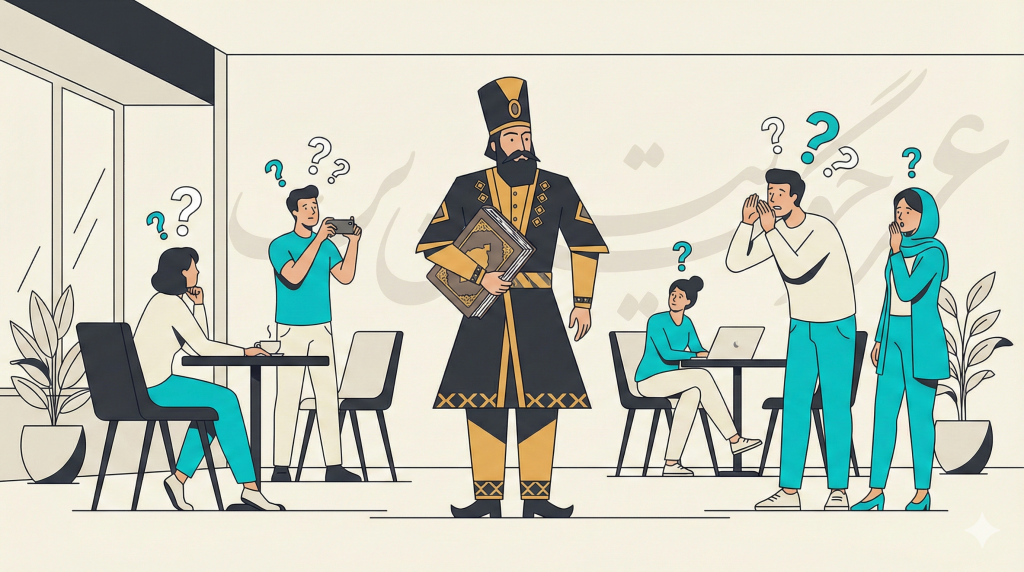
Then, you turned on a movie by Asghar Farhadi. or perhaps by Bahram Beyzaie, the giant who spent decades fighting this exact linguistic gap. Or you walked into a kebab shop in Los Angeles, Toronto, or Kensington. Or you tried to eavesdrop on a conversation in a cafe.
And you understood zero.
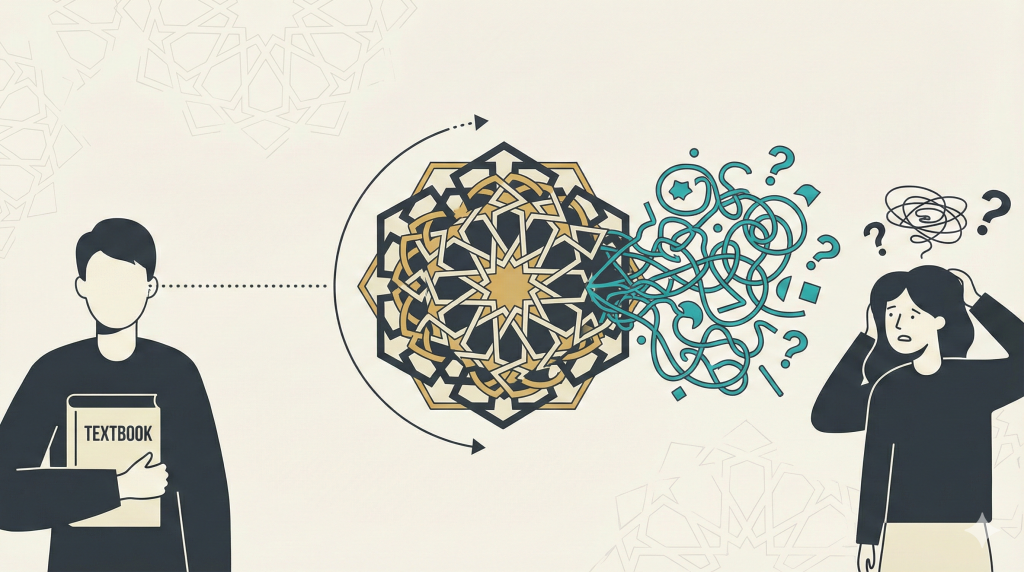
Not just “a little bit” or “the gist.” I mean zero. The words they were using didn’t sound anything like the flashcards you spent your weekends reviewing. It felt like they were speaking a code, and you didn’t have the cipher.
Were you stupid? Hmm, no… You were just the victim of a linguistic crime.
If you’re wondering whether Farsi is hard to learn, the answer depends entirely on which version you’re learning. You were taught Written Persian (Farsi-ye Ketabi), a language that is used for poetry, news anchors, and writing laws. But 99% of human interaction happens in Spoken Persian (Farsi-ye Mohaverei), specifically the Tehrani accent (the Persian language varieties are more diverse than most learners realize).
Here in Italy, where I live, dialects are regional. If I go to Naples, they speak Napulitano. If I go to Venice, they speak Veneto. But in Iran, the “dialect” isn’t just about geography, it’s about register.
If you speak Ketabi (Book Farsi) to a taxi driver in Tehran, he won’t just think you’re a foreigner. He’ll think you’re mocking him, or that you’re a time traveler from the 16th century trying to pay him in gold coins.
It’s time to learn the real language. If you want to understand the cognitive science behind why this split exists and how it literally changes the way you think, the Sapir-Whorf post goes deep on Persian and the bilingual brain.
So Welcome to the Manifesto.
2. What is Diglossia?
I’m a Political Science student, so I have to give you the technical term before we get to the fun stuff. Persian is a Diglossic Language (see Encyclopaedia Iranica on Persian diglossia for the academic treatment).
This means we have two distinct versions of the language operating simultaneously in society. (The formal/spoken gap exists in Urdu too. the Farsi-Urdu comparison shows why.). a phenomenon linguists call diglossia, and it has massive implications for how you should study:
- The High Variety (Formal/Written): Used in books, newspapers, formal speeches, university lectures, and the BBC Persian website. It is rigid, grammatical, and preserves history. It is the guardian of our culture.
- The Low Variety (Informal/Spoken): Used in the bazaar, in the bedroom, in text messages, and in 95% of Iranian cinema. It is fluid, fast, aggressive, and … efficient.
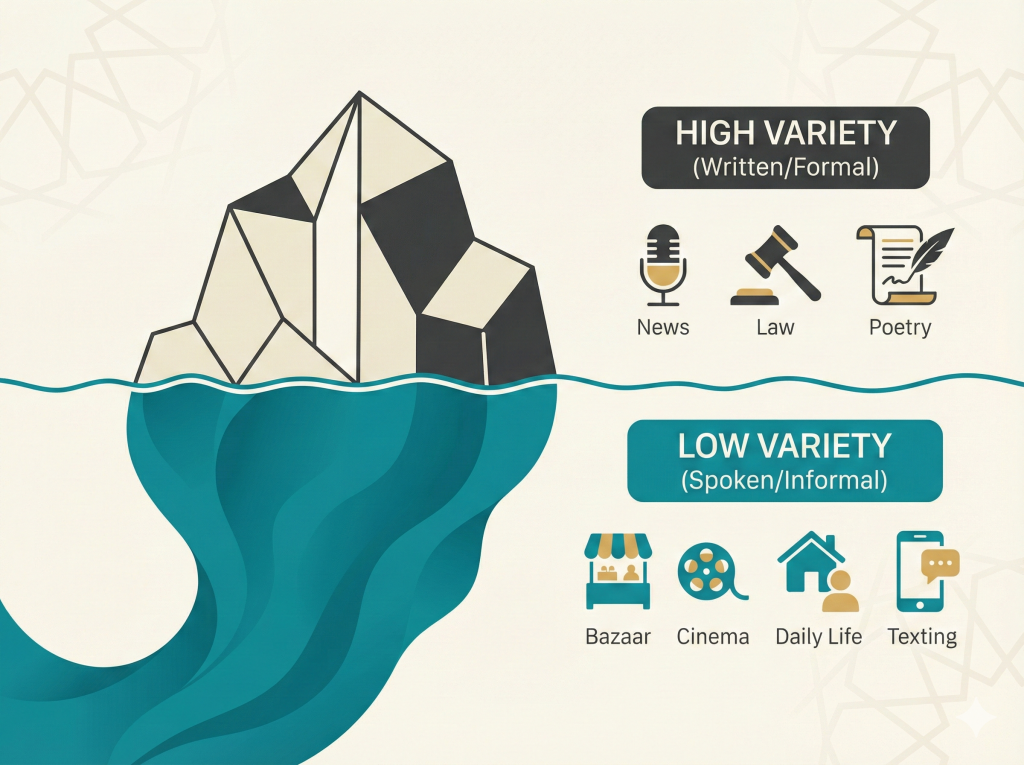
The gap between them is massive. In English, you might say “I am going to” vs. “I’m gonna.” That’s a small slide.
In Persian, the sentence changes structure, pronunciation, and vocabulary completely.
The Rule of Thumb: If you are writing an email to a professor? Use the Book. If you are trying to get a discount on a carpet? Burn the Book.
If you stick to the book, you will always be an outsider. You will be “The Foreigner.” To be “one of us” (Khodemooni), you have to break the rules.
3. The “Tehran Shift” and 3 Golden Rules to Survive
You don’t need to memorize a whole new dictionary. You just need to learn how to “break” the words you already know.
The standard spoken accent in Iran is “Tehrani.” Even if you are in Isfahan or Shiraz, everyone understands Tehrani because it’s the language of the capital and the media. It acts as the Lingua Franca of modern Iran.
Here are the three algorithms to convert your textbook knowledge into street smarts.
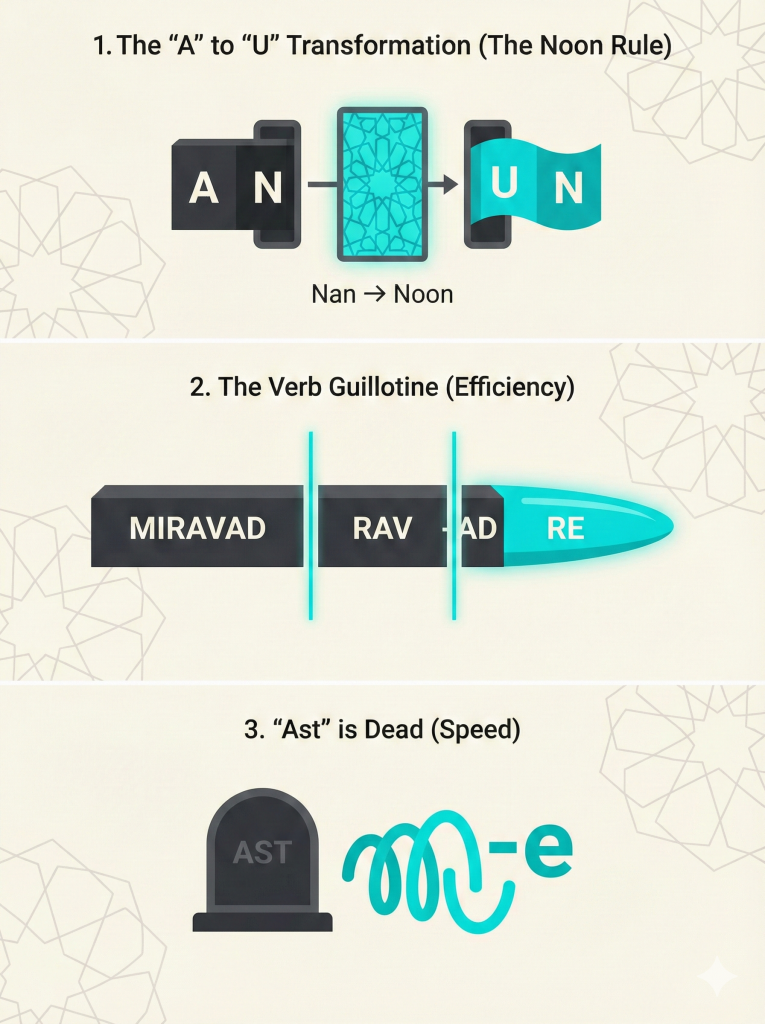
Rule #1: The “A” to “U” Transformation (The Noon Rule)
This is the most famous shift. In many words, the long “A” sound (Alef) transforms into a long “U” sound (Wav) when it comes before the letter ‘N’.
- Book: Nan (Bread) -> Street: Noon
- Book: Khaneh (House) -> Street: Khuneh
- Book: Tehran (Tehran) -> Street: Tehroon
- Book: Midan (Square) -> Street: Midun
- Book: Arzan (Cheap) -> Street: Arzun
Why does this matter? If you walk into a bakery and ask for Nan, you will get bread. But you will sound like a tourist. If you ask for Noon, you sound like a local. And locals get fresh bread. They also get the Tahdig. Tourists get the cold rice.
⚠️ The ‘Respect’ Exception: We usually don’t do this to proper nouns or names, unless we are being playful.
- Iran stays Iran (Not Iroon).
- Khashayar (Name) stays Khashayar. Don’t rename the country. It’s confusing and… dangerous.
Rule #2: The Verb Guillotine
Persians are efficient. (Or lazy, depends on how you look at it). We hate finishing our words. In the present tense, we chop off the middle and the end of the verb.
Let’s look at Raftan (To Go).
| Person | Written (Ketabi) | Spoken (Tehrani) | What Changed? |
|---|---|---|---|
| I go | Miravam (میروم) | Miram (میرم) | Dropped the ‘v’ |
| You go | Miravi (میروی) | Miri (میری) | Dropped the ‘v’ |
| He/She goes | Miravad (میرود) | Mire (میره) | Dropped ‘vad’, added ‘e’ |
| They go | Miravand (میروند) | Miran (میرن) | Dropped the ‘d’ |
The “Mige” Test:
The verb Goftan (To say) is the most common verb in the language. Textbook: Ou Migooyad (He says). Real Life: Mige.
If you say Migooyad, you sound like a grand vizier reading a royal decree. Say Mige.
Rule #3: “Ast” is Dead
The verb “is” (Ast) appears at the end of almost every formal sentence in your textbook.
- In Khoub Ast (This is good).
- Mashin Inja Ast (The car is here).
In spoken Farsi, Ast is illegal. We delete it and replace it with a simple sound: -e.
- Book: In Khoub Ast (این خوب است)
- Street: In Khoube (این خوبه)
- Book: Kojast? (Where is it? – Koja Ast)
- Street: Kojas? (Dropped the ‘t’)
This small change speeds up the language by about 30%. See exactly what happens to sounds in fast Tehrani speech in our connected speech guide. And if you’re wondering why you studied for months but still can’t follow a real conversation, the listening gap explained. it’s not you, it’s the gap between textbook audio and how Iranians actually talk.
4. The “Right Now” Tense: The Daram Hack
This is the secret weapon that intermediate students usually miss.
In Standard Written Persian, Miravam means both “I go” (habitual) and “I am going” (progressive).
- Man har rooz be madreseh miravam. (I go to school every day).
- Man alaan be madreseh miravam. (I am going to school now).
In Spoken Persian, we hate ambiguity. We want to emphasize that we are doing the action right now. To do this, we use the verb Dashtan (To have) as a helper.
Structure:
Conjugated Dashtan + Conjugated Main Verb
Example: “I am going” (Right now, I am walking out the door)
- Daram Miram (Literally: “I have I go”).
Example: “I am eating”
- Daram Mikhoram (Literally: “I have I eat”).
Example: “He is writing”
- Dare Minevise (Literally: “He has he writes”).
If your friend calls you and asks “Where are you?”, do not say Miram Khuneh (I go home). That sounds vague. Say Daram miram khuneh (I am currently in the process of going home).
This structure does not exist in the formal written language. If you use it in an academic essay, you will fail. If you use it in the street, you sound like a native.
5. The Grammar of the Street: Object Markers & Possessives
This is where the “speed” of the language comes from. We shorten grammatical particles to flow better.
A. The Object Marker (Ra vs. o)
In Persian grammar, we use Ra (or Raa) to mark a specific direct object.
- Book: Man Ketab Ra Didam (I saw the book).
In spoken Farsi, Ra transforms into -o or -ro.
- Street: Man Ketabo Didam.
- Street: Man Mashino Kharidam (I bought the car).
If the word ends in a vowel, it becomes -ro:
- Book: Man Khaneh Ra Didam.
- Street: Man Khuneh ro Didam.
🛑 Stop Saying: Man Ghormeh Sabzi Ra Doost Daram. (I like Ghormeh Sabzi).
✅ Say This: Man Ghormeh Sabzi ro Doost Daram.The first one sounds like a robot. The second one sounds like a hungry person.
B. The Possessive Shortcut (-e Man vs. -am)
In your book, you learned to use Ezafe (the connector -e) + the pronoun to show ownership.
- Mashin-e Man (My car – Literally “Car of me”).
- Dust-e To (Your friend – Literally “Friend of you”).
This is correct, but clunky. In Spoken Farsi, we prefer Suffixes.
| English | Book (Long Way) | Street (Suffix Way) |
|---|---|---|
| My Car | Mashin-e Man | Mashinam |
| Your Car | Mashin-e To | Mashinet |
| His/Her Car | Mashin-e Ou | Mashinesh |
| Our Car | Mashin-e Ma | Mashinemoon |
| Their Car | Mashin-e Shan | Mashineshoon |
Using suffixes (Mashinam, Ketabam, Pulam) makes you sound 10x more fluent than listing out pronouns every time.
6. The Vocabulary Traps: False Friends
Some words are technically “correct” in the dictionary, but socially weird. Using them ruins the vibe.
Here is a conversion table for your social life.
| English | The “Textbook” Word | The “Street” Word | El’s Note |
|---|---|---|---|
| Thank You | Motashakeram | Mersi / Mamnoon | Yes, we stole Mersi from the French. Use it. Motashakeram is for job interviews. |
| Hello | Dorood | Salam | Dorood is Pre-Islamic and poetic. Use it if you want to make a political statement about Aryan history. Use Salam if you just want to say hi. |
| How are you? | Hal-e Shoma Chetor Ast? | Chetori? / Khubi? | Chetori literally means “How are you-ish?” It’s the standard greeting. |
| Please | Lotfan | Bi-zahmat | Lotfan is fine, but Bi-zahmat (Without trouble) is the polite way to ask for a favor in a shop. |
| Yes | Baleh | Are / Ahan | Baleh is polite/formal. Are is casual. Ahan means “Oh, I see.” |
| No | Nakhayr | Na | Nakhayr is emphatic and formal. Just say Na. |
7. The “Yek” Disappearance
This is a tiny detail that screams “Fluency.” The number One is Yek. But as an article (a/an), we almost never pronounce the ‘k’.
- Book: Yek Mard (A man).
- Street: Ye Mard.
- Book: Yek Lahzeh (One moment).
- Street: Ye Lahzeh.
Dropping that hard ‘k’ sound makes your sentence flow much smoother. Ye Lahzeh sounds like a plea. Yek Lahzeh sounds like a command.
8. Why We Do This (The Political Angle)

You might be asking: “Elyar, why is it so complicated? Why not just speak how you write?”
It comes down to Intimacy (Samimiyat).
In Iranian culture, social hierarchy is everything. We have “Tarof” (politeness rituals) to navigate these hierarchies.
- Written Persian represents distance, formality, and respect. It puts a wall between you and the listener. It says “I respect you, but I don’t know you.”
- Spoken Persian breaks the wall. It invites the listener into your inner circle.
This spoken/written split is also deeply connected to ta’ārof. Iran’s social operating system. If you want to understand the cognitive science behind why Iranians communicate indirectly, Ta’ārof Is Not Politeness breaks down the game theory, theory of mind, and Gricean violations that make it work. If you meet an Iranian peer (someone your age) and you speak Ketabi to them, you are subconsciously signaling: “I want to keep this formal. I don’t want to be close to you.”
By switching to Mahiane (Street Farsi), you are signaling: “We are cool. We are equals.”
However, context is king. If you go to the Immigration Office (Edareh) to renew your visa, do not say Chetori Dadash? (How are you, bro?). You switch back to Ketabi. You become the poet. You use Motashakeram and Baleh.
Mastering Persian is not about knowing one language; it’s about knowing which mask to wear.
9. Strategy:Then How to Learn Without Going Crazy?
Do not burn your textbooks. You need the alphabet. You need the roots.
If you try to learn only by ear, you will be illiterate. You won’t be able to read a menu or a street sign.
The Strategy: The “Jazz” Approach Treat the written script like sheet music. You see the notes on the page, but you play them with improvisation.
- Read: Nemidanam (I don’t know).
- Brain Process: Recognize the root. Apply the algorithm (Verb Chop + Vowel Shift).
- Speak: Nemidunam.
Homework for this week: Go to YouTube and watch an interview on Radio Javan or a clip from the show Khandevane. Do not watch the news. Watch people interrupting each other. Listen for the Mige, the Mire, and the Noon.
Once you hear it, you can’t unhear it.
Reading this is easy; using it is hard.
I’m a PolSci student in Italy, and I deal with context every day. Most apps won’t correct your pronunciation of Miravam. in fact, this formal-only problem plagues nearly every learning app on the market. I tested 14 of them in my best apps for learning Farsi guide, and the results aren’t pretty. But I will correct you.
I can teach you the Farsi that actually gets you a date, not the Farsi that gets you a library card.
See the register gap in daily verbs: routine vocabulary puts formal and spoken forms side by side for 30 everyday actions. The conversation series teaches you to use these spoken forms in real dialogues. from ordering food to navigating family gatherings. For mastering both registers at an advanced level, the advanced Persian guide covers style-switching, nuance, and the subtleties that separate good Farsi from great Farsi. Before you go: if you want to understand the grammar behind formal and spoken Persian, start with our complete grammar reference. If you want to start with the most important spoken Farsi phrase to add to your vocabulary, read The Mérsi Hack. And for slang that actually comes up in daily conversation, 10 Farsi Slang Words You Actually Need is where to start.
If you grew up hearing Farsi at home but can’t produce it fluently, you’re dealing with a specific version of this gap. check out our heritage Farsi learner guide for a path built around what you already know. If you want to see these register shifts in action across 100+ food words, our Persian food vocabulary reference shows formal and spoken forms side by side. The gap between written and spoken widens further when you start writing by hand. handwriting vs print shows how Iranians simplify letter forms in daily writing, a whole separate layer of “breaking the rules.”
To hear the spoken-vs-written gap in action across dozens of real scenarios, the One Scene a Week series gives you 24 dialogues in pure Tehrani spoken Farsi. with formal equivalents in every episode. The Persian Poetry series shows how classical written Persian relates to modern spoken forms. And the Iranian Movies guide picks the best films for hearing real spoken Farsi at every level.
Book a ‘Street Farsi’ audit on Preply
For the complete system. verb contractions, vocabulary swaps, grammar changes, and practice dialogues. see our full guide to spoken vs. written Farsi.