You’re in Delhi, not some cozy walkable European town. In May, the heat on Outer Ring Road feels like a hair dryer on full blast. The PM 2.5 levels are at “why is my throat burning” and an Uber from Noida Sector 62 to Green Park can easily take an hour and a half at rush hour. Now imagine doing that twice a week just to sit in a classroom and conjugate verbs from a 1980s Persian textbook.
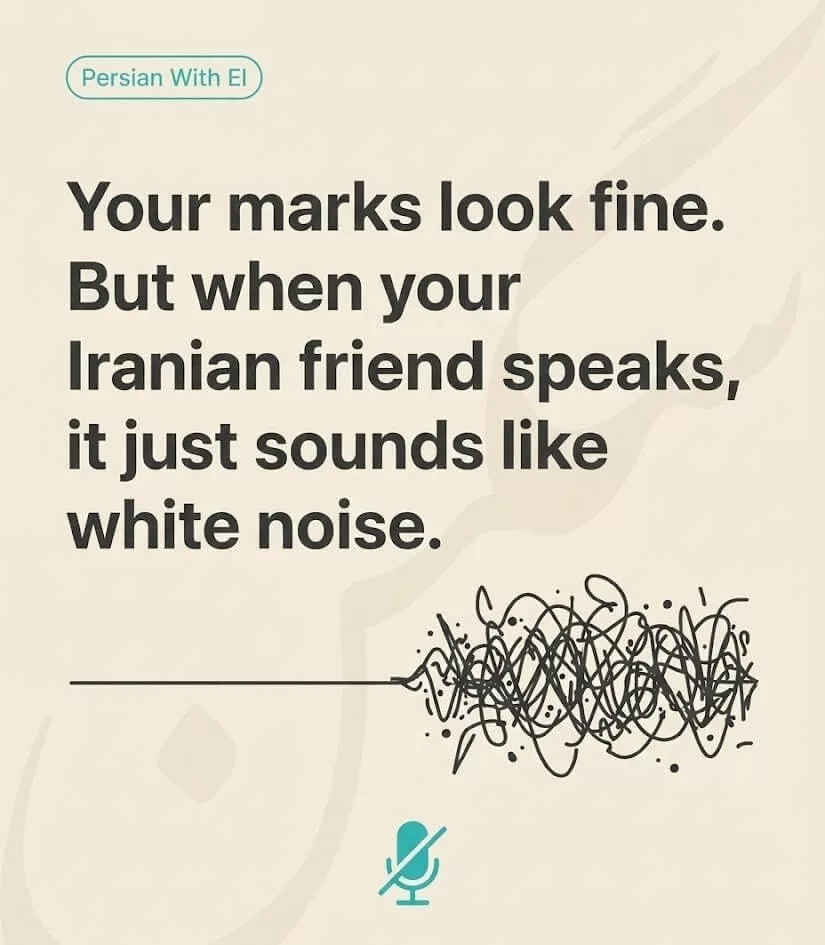
If you’ve already tried a Persian course at JNU, Jamia, Delhi University, or with a private tutor near Lajpat Nagar or Kailash Colony, you probably know this pain. Your marks look fine, but when you open Netflix and put on a Tehrani series, you catch maybe 10%. And when your Iranian friend says something in fast street Farsi, it just sounds like white noise.
You’re committed to learning Persian in Delhi partly out of guilt and partly because you’re tired of nodding through conversations. But you also know one thing very clearly: adding another sweaty commute through South Ex, AIIMS, or the Noida to Greater Noida Expressway just to be taught poetry and grammar tables is not it.
So let’s talk about what Farsi learning in Delhi really looks like. We need to look at where the good intentions are, where the gaps are, and how to get to real, usable Tehrani Farsi without sacrificing your sanity to Delhi traffic.
Why Learning Persian in Delhi Often Misses the Real Needs of Learners
Delhi actually has more Persian options than many cities like Hong KONG. You’ve got full university departments, cultural centers, and language schools. On paper, that sounds amazing. In reality, most of these options are built for a totally different learner than you.
You’re not an 18-year-old BA student looking to read classical poetry slowly over six semesters. You’re someone with a job, a life, and probably a polluted commute already built in. You need Farsi that works in WhatsApp chats, in family dinners, in embassies, and Zoom calls. You don’t just need it for exam papers.
The “Ketabi” Problem and Why Textbook Persian Misleads Students
Most Farsi classes in Delhi are built around ketabi, which is formal, written Persian. That’s the language of news anchors, essays, and official speeches. It’s not how people in Tehran actually talk on the street, online, or at home.
Typical university and traditional courses in Delhi focus on:
- Classical texts (Hafez, Sa’di, Rumi)
- Heavy grammar explanation in English or Hindi
- Reading and translation, not fast listening or natural speaking
So you work hard and pass your exams. Maybe you can decode a paragraph from a 19th‑century text. But then you hear modern Iranians and think, “Is this even the same language?”
Here’s why ketabi can mislead you. It gives you a false sense of security. You feel like you “know Persian” because you can read, but when you need to use it, you freeze. That’s the classic diglossia shame. Your brain is full of correct forms that no one around your age actually uses out loud.
How Colloquial Tehrani Persian Changes Everything for Actual Conversations
Real people in Tehran 2025 use mohavereh, casual, spoken Farsi. It has different vocabulary, faster rhythm, dropped endings, and a lot of slang. If your journey of learning Persian in Delhi never leaves the textbook, you’ll sound like you time‑traveled from the Shah’s television studio.
To see the gap, look at these pairs (formal ketabi vs Tehrani mohavereh):
- Formal: من بسیار خرسندم که شما را ملاقات میکنم. man besyār khorsandam ke shomā rā molāghāt mikonam. “I am very delighted to meet you.”
- Street: خیلی خوشحال شدم دیدمت. kheyli khoshhāl shodam didamet. “Nice to see you.”
- Formal: حال شما چگونه است؟ hāl-e shomā chegoone ast? “How are you?”
- Street: خوبی؟ / چطوری؟ khobi? / chetori? “You good?” / “How’s it going?”
Same language. Completely different social vibe. The formal lines will pass your Delhi exams. The street ones will actually keep a conversation with a 28-year-old Tehrani going.
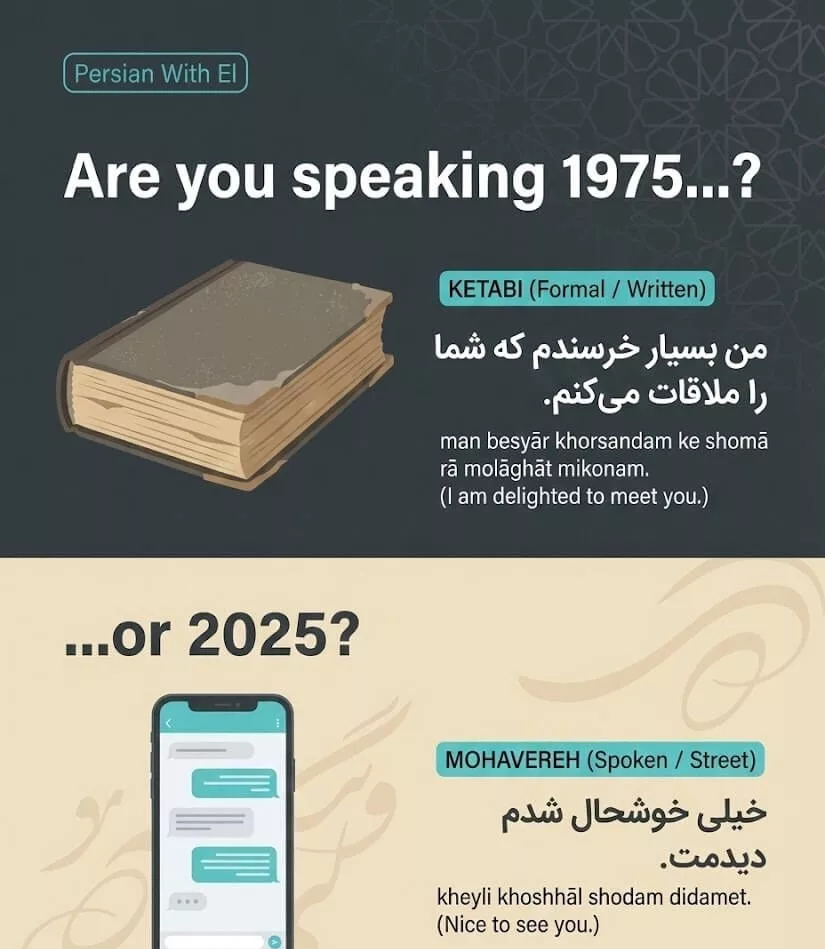
If your goal is to talk to a partner’s family, chat with Iranian colleagues, or follow modern Iranian media, you need your classes to prioritize Tehrani mohavereh. Otherwise, you’ll always feel like you’re cosplaying as a newsreader at a casual chai stall in Hauz Khas Village.
What Serious Learners in Delhi Expect but Rarely Receive
People looking for Farsi classes in Delhi usually fall into a few groups, and almost all of them get underserviced by old-school programs. You’re not just learning “for fun.” There’s usually a real emotional or professional stake behind it.
Heritage Speakers Who Want More Than Childhood Exposure
Some Delhi learners grew up with Iranian or Afghan relatives, or in families connected historically to Persian. Maybe your grandparents know some Urdu‑Persian mix, or a parent speaks Dari, but you were raised in English and Hindi.
You understand a few words like salaam, merci, or khodāfez. But when family members switch to fast Farsi, you’re out. That’s where the shame kicks in.
Heritage learners in Delhi usually want:
- To speak comfortably with family during visits to Iran, or when relatives come to South Delhi or Noida
- To understand jokes and emotional nuances, not just literal meaning
- To fix fossilized mistakes from half‑remembered childhood phrases
University-style Persian here rarely addresses that. It’ll teach you how to read an old ghazal before it teaches you how to argue with your cousin about football in casual Farsi.
Partners Preparing for Family Dynamics That Textbooks Never Explain
Then there are relationship learners. Maybe you met your partner at JNU, in a cultural event at Iran Culture House in Chanakyapuri, or online and now they’re in Tehran. You don’t just want to say “I love you” in Persian. You want to survive dinner with their parents.
Textbooks won’t prepare you for:
- Tarof (polite lying, basically) in real time
- What you call your in‑laws without sounding rude or too distant
- How to refuse food without starting a minor diplomatic crisis
Most classes in Delhi don’t go anywhere near this. You’ll get “formal vs informal pronouns” and that’s it. Relationship learners need live practice with a Tehrani accent, role-plays, and cultural coaching.
Professionals Who Need Persian That Works in High Pressure Settings
Delhi also has a quiet but serious group of learners. This includes diplomats, journalists, academics, NGO staff, and sometimes defense or policy people. If you work near Chanakyapuri, Central Secretariat, or in think tanks in Jor Bagh or Green Park, you know the stakes.
You might need Farsi for:
- Reading Iranian news and policy documents quickly
- Having off‑record chats with Iranian counterparts
- Navigating conferences, negotiation rooms, or field visits
Traditional university courses at JNU, Jamia Millia Islamia, or Delhi University give you solid reading skills eventually. However, they are slow, semester‑bound, and literature‑heavy. They don’t always build the listening and speaking speed you need for actual briefings, informal chats, and last‑minute calls.
Serious learners in Delhi expect something more modern. They need focused speaking drills, authentic audio from Tehran, and teachers who understand both the linguistic and political context. That’s still rare.
The Farsi Learning Options in Delhi (and the Hidden Gaps in Each One)
Compared to many cities, Delhi offers quite a few paths. When it comes to learning Farsi in Delhi, the issue isn’t “nothing exists”. It is a question of what exists and who it is designed for.
University and Community College Courses
As of 2025, you can study Persian at places like Jawaharlal Nehru University (Centre of Persian and Central Asian Studies), Jamia Millia Islamia (Department of Persian), and University of Delhi colleges such as Zakir Husain Delhi College. These programs are very real, very established, and respected.
They’re great if you want a degree or care about classical literature and Indo‑Persian history. They are not so great if you are working full time in Gurugram or Noida and can’t commute to campus regularly.
These courses are heavily ketabi‑weighted. Expect a lot of grammar explanation and translation exercises. Expect very little of “How do I actually sound normal in a Tehran café?”
Private Tutors Who May Know Persian but Not Pedagogy
If you search on UrbanPro or similar platforms for “Persian tutor in Delhi”, you’ll see dozens of options. Some of these tutors are excellent. Others are just native speakers or heritage speakers who’ve never studied how to teach. That matters. Knowing Persian doesn’t automatically mean knowing how to break it down for an adult learner who already speaks English and maybe Hindi or Urdu.
Common issues with random private tutoring in Delhi include an over‑focus on grammar explanations in English or Hindi and no clear curriculum.
Cultural Centers That Offer Immersion Without Structure
Delhi also has the Iran Culture House in Chanakyapuri and related initiatives. These spaces can give you cultural events and some level of immersion.
The downside is that courses there tend to be traditional and grammar‑first. They are not always optimized for the 32-year-old working professional who lives in Dwarka and has exactly one free evening per week. There are also private language schools in Delhi, like Zabaan School for Languages, that have offered Persian courses. They are often more structured, but schedules can be rigid.
The big pattern across all these options is clear. There are lots of good intentions, but the center of gravity is almost always formal Persian, a slow pace, and heavy commuting.
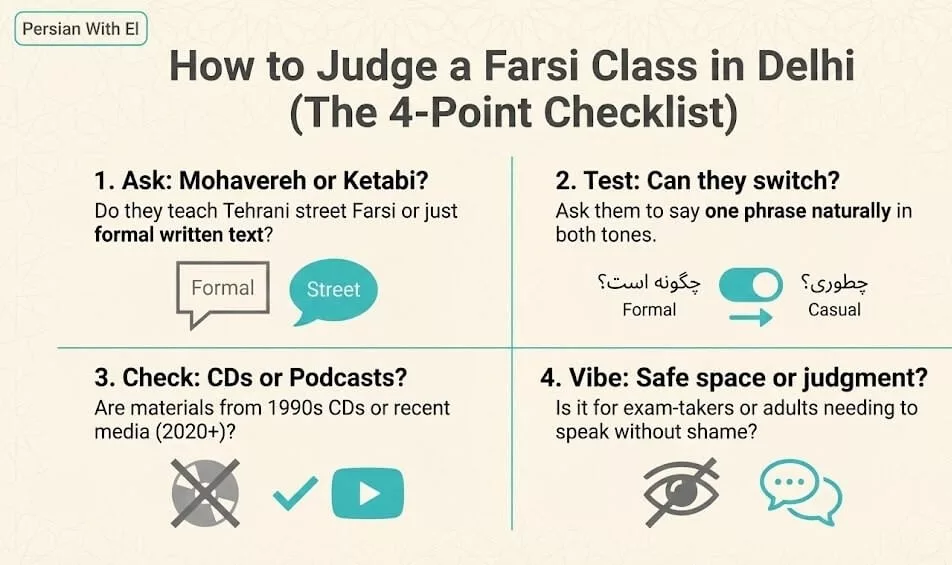
How to Judge a Farsi Class in Delhi Before You Enroll
Before you sign up for anything, whether it’s a university elective in North Campus or a tutor in Saket, you need to filter aggressively. Delhi already burns enough of your time in traffic. Your Farsi class shouldn’t add to that without delivering.
Questions That Reveal Whether the Teacher Understands Colloquial Persian
When you talk to a potential teacher or school, ask very direct questions. Their answers will tell you instantly whether they live in 1975 or 2025.
- “Do you teach Tehrani colloquial Farsi (mohavereh) or mainly formal/written Persian?” If they hesitate or say “We focus on grammar first, speaking will come later,” that’s a red flag.
- “Can you show me how you’d say the same sentence in formal Persian and in everyday Tehrani speech?” You’re checking if they can switch registers naturally.
- “What kind of audio/video materials do you use?” If the answer is “CDs” or very old recordings, that is not good. You want series, YouTube, and podcasts from the last few years.
Good teachers, online or in Delhi, will happily say words like slang, Tarof, Tehran accent, and voice notes practice.
Signals That Show the Course Fits Your Identity
There’s also the identity fit question. Especially if you’re a heritage learner or in a relationship with an Iranian, you don’t want The Auntie Gaze. That is the feeling of being judged for your accent, clothes, or life choices.
Notice who is in their typical class. Is it school kids? Exam‑oriented university students? Or adults like you? In a good class, you’ll feel safe making mistakes and asking “stupid” questions like “Okay, but what do people actually say at the dinner table?” If the vibe is more “recite this poem perfectly or be silently judged,” that’s your sign to bail.
The “Delhi Traffic” Test for Your Language Learning
Given Delhi’s geography, weather, and work culture, it’s not surprising that more and more serious learners quietly shift most of their Farsi study online.
Between heatwaves over 45°C, winter smog, and commutes that can stretch from Gurugram to JNU or Noida to Jamia for more than an hour each way, adding another regular physical class is a huge ask.
Online lessons give you no commute from Dwarka, Ghaziabad, Gurugram, or Noida. You get the ability to schedule around your real life. Most importantly, you get space to show up in a T‑shirt on your couch, not sweaty and half‑dead from Ring Road.
Stop Conjugating, Start Speaking
If you are tired of sacrificing two hours in traffic just to be taught textbook Persian, try a different approach.
Frequently Asked Questions
What should I look for when choosing Farsi classes in Delhi?
When evaluating options for learning Persian in Delhi, ask if they teach Tehrani colloquial Farsi (mohavereh) or only formal written Persian. Check whether they use recent audio or video from Iran rather than old textbooks. You should also ask how soon you will start real conversations and if the schedule realistically fits your work commute in NCR.
Why do so many courses focus on textbook Persian instead of spoken Farsi?
Most traditional programs at Delhi universities and cultural centers were designed for literature and academic study. They prioritize classical texts, grammar explanations, and translation. This results in strong reading skills but weak listening and speaking in the modern Tehrani street Farsi used in real life.
Are online Farsi classes better than in‑person classes in Delhi?
For many working adults, online instruction is more effective because it avoids long commutes from places like Gurugram or Noida. It allows for flexible scheduling and gives you access to native Tehrani speakers who might not be available locally. In‑person classes can help with community, but they often remain grammar‑heavy and slower to build real conversational skills.
How long does it take to speak conversational Tehrani Farsi?
With consistent study of 2–4 hours per week plus self‑practice, many motivated learners can reach basic conversational proficiency in about 6–9 months. Reaching a comfortable level where you understand nuances typically takes 12–18 months, especially if you focus on spoken mohavereh and real audio.