I’m standing outside a café near Porta Garibaldi, wrapped in a coat that cost half my rent, trying to see through the Milanese nebbia (fog). My phone buzzes with a notification from a Persian news channel. It’s not about sanctions, and it’s not about the dollar hitting a new record. It’s a photo of a man with white hair and piercing eyes. Bahram Beyzaie, the absolute giant of Iranian cinema and theatre, has died at 87.
For a moment, the noise of the Milan tram fades out. In Tehran, when a politician dies, people make memes. When a legend like Beyzaie dies, the timeline goes quiet, then it floods with poetry. This isn’t just celebrity news; it’s the end of an era for the Iranian intelligentsia who view art as a form of survival. If you want to understand the soul of modern Iran beyond the angry headlines, you need to know why this man’s death matters.
Who Was Bahram Beyzaie?
Bahram Beyzaie wasn’t just a filmmaker; he was an encyclopedia of Persian history walking on two legs. He directed masterpieces like Bashu, the Little Stranger and wrote plays that redefined the Persian language. Think of him as the Iranian Akira Kurosawa mixed with Shakespeare, but with more censorship headaches. He spent the last years of his life in exile, teaching at Stanford, because his work was often too heavy, too complex, or just too “historical” for the authorities to handle comfortably.
The “Human Angle”: How Iranians Mourn a Legend
The reaction to his death is a masterclass in Iranian cultural grief. You won’t see official state funeral parades. Instead, you see a spontaneous digital wave of soogvari / سوگواری (mourning). Students, actors, and writers are posting black-and-white photos, quoting his plays, and talking about “orphaned cinema.” It’s a reminder that for us, artists are the real leaders. They hold the collective memory that politics tries to erase.
The Deep Dive: Learn Persian Through the Headlines
If you want to sound like a Tehran intellectual (or just read the news without a dictionary), here are the key words you need to navigate the coverage of the Bahram Beyzaie death news.
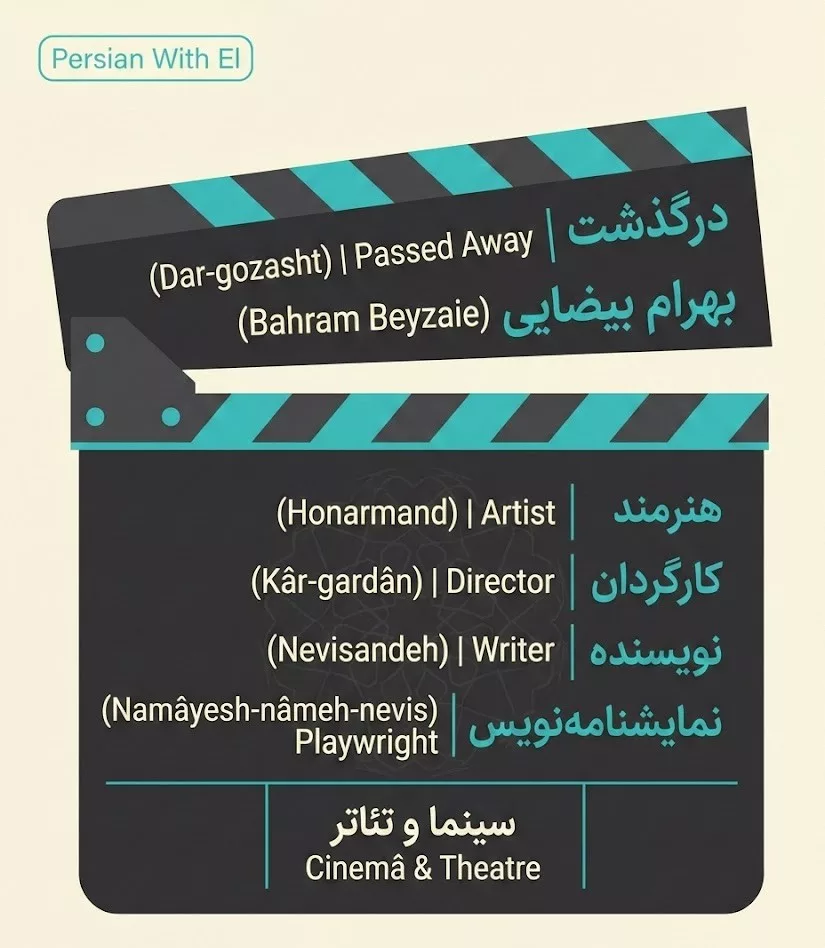
1. The News Word: Dar-gozasht
- Literal Meaning: Passed away / Died.
- Street Context: This is the formal, respectful word used in news or formal announcements. You wouldn’t use it for a dead car battery or a houseplant. It implies dignity.
- Example:Bahram Beyzaie emrooz dar-gozasht. (بهرام بیضایی امروز درگذشت.)
- Translation: Bahram Beyzaie passed away today.
2. The Identity: Honarmand
- Literal Meaning: Artist.
- Street Context: In Iran, honarmand is a heavy word. It’s used for actors, painters, and musicians, but sometimes sarcastically for someone who is being dramatic. In this context, it’s pure respect.
- Example:Oon ye honarmand-e vaghe-ie. (اون یه هنرمند واقعیه.)
- Translation: He is a true artist.
3. The Holy Trinity of Careers
Beyzaie was a triple threat, so you need these three job titles to describe him properly.
- Kâr-gardân (کارگردان): Director.
- Usage: The boss on set.
- Example: Behtarin kâr-gardân-e Iran bood. (بهترین کارگردان ایران بود.) -> “He was Iran’s best director.”
- Nevisandeh (نویسنده): Writer.
- Usage: Anyone who writes books, articles, or scripts.
- Example: Man mikham nevisandeh besham. (من میخوام نویسنده بشم.) -> “I want to become a writer.”
- Namâyesh-nâmeh-nevis (نمایشنامهنویس): Playwright.
- Usage: A bit of a tongue-twister, but essential for theatre fans. Namâyesh (show) + nâmeh (letter/book) + nevis (writer).
- Example: Beyzaie bozorgtarin namâyesh-nâmeh-nevis-e ma hast. (بیضایی بزرگترین نمایشنامهنویس ما هست.) -> “Beyzaie is our greatest playwright.”
4. The Mediums: Sinamâ & Te’âtr
- Literal Meaning: Cinema & Theatre.
- Street Context: These are cognates (loan words from French/English), so they are easy to remember. Te’âtr in Tehran is a very “uptown” hobby.
- Example:Birim sinamâ ya te’âtr? (بریم سینما یا تئاتر؟)
- Translation: Should we go to the cinema or the theatre?
Final thought
In Italy, statues are made of marble and stand in piazzas. In Iran, our statues are made of words and film reels, and they live in our collective memory. Bahram Beyzaie has just become a statue.
Rest in peace, Ostad.