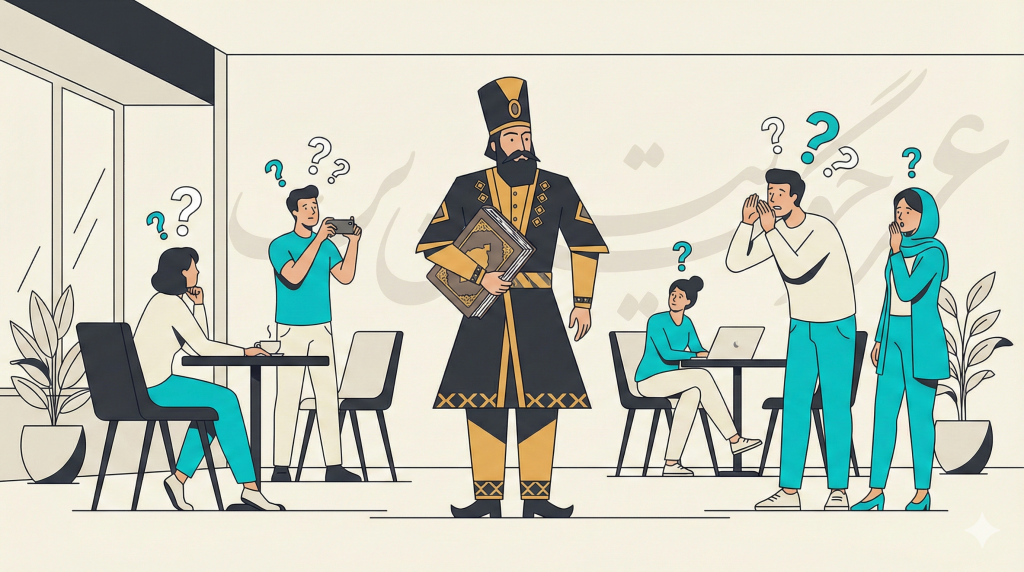
In Italy, where I currently live, the ego is practically a national monument. When I’m sitting in a café here in Messina and an Italian student wants to answer a question, they launch with a loud, chest-thumping “Io!” (I). They own the opinion. They own the room. It is absolute Main Character Energy.
Try that in Tehran and people will quietly decide you are insufferable.
Okay, “insufferable” is strong. But if you walk into a room in Iran and keep hammering Man (من). the Farsi word for “I”. you will come across as arrogant, raw, and socially tone-deaf. You might know your Persian grammar inside out. You might know that Man technically means “I.” But the moment you tell a potential father-in-law “Man tasmim gereftam” (I decided), you sound less like a partner and more like a dictator.
To speak like a local. and not like a tourist clutching a textbook. you need to understand a fundamental rule of Persian etiquette: the individual does not exist. The group does.
Why Persian Pronouns Are Optional in the First Place
Here is the part most Farsi courses skip entirely. In Persian, verb conjugation already tells the listener who is speaking. Every verb ending is tagged with the subject. Watch:
| With pronoun | Without pronoun | Translation |
|---|---|---|
| من میرم (Man miram) | میرم (Miram) | I’m going |
| من گفتم (Man goftam) | گفتم (Goftam) | I said |
| من میخوام (Man mikham) | میخوام (Mikham) | I want |
| من دیدم (Man didam) | دیدم (Didam) | I saw |
The -am ending already screams “first person singular.” Adding Man on top of it is like signing your name at the bottom of a text message. technically correct, completely unnecessary, and a little weird.
So when Iranians drop the pronoun, they are not being lazy. They are being efficient and humble at the same time. Every extra Man you throw in is a tiny neon sign flashing “Me! Me! Look at me!”. and in a culture built on taarof and ritual humility, that sign gets noticed fast.
The “Reverse Royal We”
In European history, kings and queens used the “Royal We” (Pluralis Majestatis) to inflate themselves. “We are not amused,” said Queen Victoria, implying she was so massive she counted as multiple people.
In Iran, we use the plural to shrink ourselves. It is a Reverse Royal We.
When you refer to yourself as Ma (ما). “We”. instead of Man (من). “I”. you are signaling humility. You are suggesting that your opinion is not yours alone; it is a collective thought, or that you are simply too insignificant to stand on your own.
Compare these two sentences:
- Man mikham (من میخوام). “I want” → a demand.
- Ma mikhastim (ما میخواستیم). “We wanted” → a gentle suggestion.
Even if you are literally the only person in the room, the plural softens the blow of your presence. It turns a command into a collaboration. If you have been sounding like a 19th-century poet because your textbook taught you ultra-formal Persian, this “we” trick is the fastest way to sound more natural in everyday conversation.
Strategic Ambiguity: Why “We” Is a Power Move
I study Political Science, so I cannot help looking at language through the lens of power dynamics. In a high-context culture like Iran, language is your primary defense system.
Using “We” is not just about being polite. it is strategic ambiguity. If you say, “I propose this plan,” and it fails, you are the idiot. You own the failure. But if you say, “We propose this plan,” and it fails, it was a collective misalignment. Blame diffused. Face saved.
By defaulting to Ma, you spread the risk. You remove the target from your back. Think of it as a linguistic insurance policy against the Evil Eye (cheshm) and social judgment. In the West, we are taught to take credit. In Iran, we are taught to deflect it. and the grammar is literally built to help you do that.
The Ultimate Humility Hack: Enter “Bandeh”
If Ma is for general politeness, then Bandeh (بنده) is for when you need to completely disarm someone.
Bandeh literally translates to “slave” or “servant.”
Now, do not freak out. When a businessman in Tehran says Bandeh arz kardam (بنده عرض کردم). “This servant stated…”. he is not offering to clean your shoes. He is performing a verbal bow. He is voluntarily lowering his status so that your status appears higher by comparison.
This is the core engine of Taarof (Persian ritual politeness). In the West, negotiation is two people trying to look big. In Iran, the winner is often the one who knows how to look small. because looking small builds trust. It is the same instinct behind the way Iranians say “no” without ever actually saying no.
A Grammar Trap With Bandeh
Here is a mistake that catches almost every student I teach. If you use Bandeh, the verb stays singular. You are a servant, but you are still one person.
- Correct: بنده گفتم (Bandeh goftam). “This servant said.”
- Wrong: بنده گفتیم (Bandeh goftim). “This servant we said.” That just sounds confused.
Keep Bandeh singular. Keep Ma plural. Mix them up and you will get a very polite, very puzzled look from whoever you are talking to.
Quick Cheat Sheet: Picking the Right Pronoun
Context is everything. Do not go around calling yourself a slave at a hip pizza place in Northern Tehran. you will look like a sycophant (Chaploos / چاپلوس). And yes, Iranians have very creative words for people who get the tone wrong.
| Situation | Use | Why |
|---|---|---|
| Friends & family | Drop the pronoun or use Man (من) | Be authentic. The verb ending is enough. |
| Strangers, professors, taxi drivers | Ma (ما). “We” | Safe, humble, universally respected. |
| Boss, police, formal clients | Bandeh (بنده). “The Servant” | Maximum diplomacy. Verbal armor. |
Putting It All Together: A Mini-Dialogue
Imagine you bump into your friend’s dad at the bazaar. He asks what you are doing these days.
Tourist version (too many “I”s):
من الان دارم فارسی یاد میگیرم. من خیلی دوست دارم. من هر روز تمرین میکنم.
Man alan daram Farsi yad migiram. Man kheili dust daram. Man har ruz tamrin mikonam.
(I am learning Farsi now. I really like it. I practice every day.)
Local version (pronouns dropped, humble):
الان داریم یه کم فارسی یاد میگیریم. خیلی بهمون خوش میگذره. هر روز تمرین میکنیم.
Alan darim ye kam Farsi yad migirim. Kheili behemun khosh migzare. Har ruz tamrin mikonim.
(We’re picking up a bit of Farsi. We’re really enjoying it. We practice every day.)
Same information. Completely different social signal. The first version sounds like a press conference. The second sounds like someone who actually lives in the culture.
The Bigger Picture
Persian pronouns are not just grammar. they are a social GPS. Every time you choose between Man, Ma, and Bandeh, you are telling the listener exactly how much space you think you deserve in the conversation. Get it right and doors open. Get it wrong and, well, you will be the subject of someone’s dinner-table story.
Language frames your reality. In English, the default reality is “Me vs. The World.” In Farsi, the reality is a network where standing out is dangerous. If you want to survive the social streets of Iran, stop being an “I” and start being a “We.” And if you want to pick up more of the real street-level Farsi that textbooks ignore, that is the mindset to start from.
Where to Go Next
Now you know why Iranians drop their pronouns. but knowing and doing are two different things. The fastest way to build the habit is live conversation with someone who will actually correct you in real time, not just nod politely while you butcher the taarof.
I teach Persian on Preply, and I focus on exactly this kind of cultural-grammar overlap. the stuff that textbooks skip and that makes the difference between “impressive for a foreigner” and “wait, are you Iranian?” If that sounds useful, grab a trial lesson here and let’s get your pronouns (or lack of them) sorted out.
This pronoun gap is just one piece of the puzzle. The spoken vs. written Persian divide runs much deeper than pronouns.