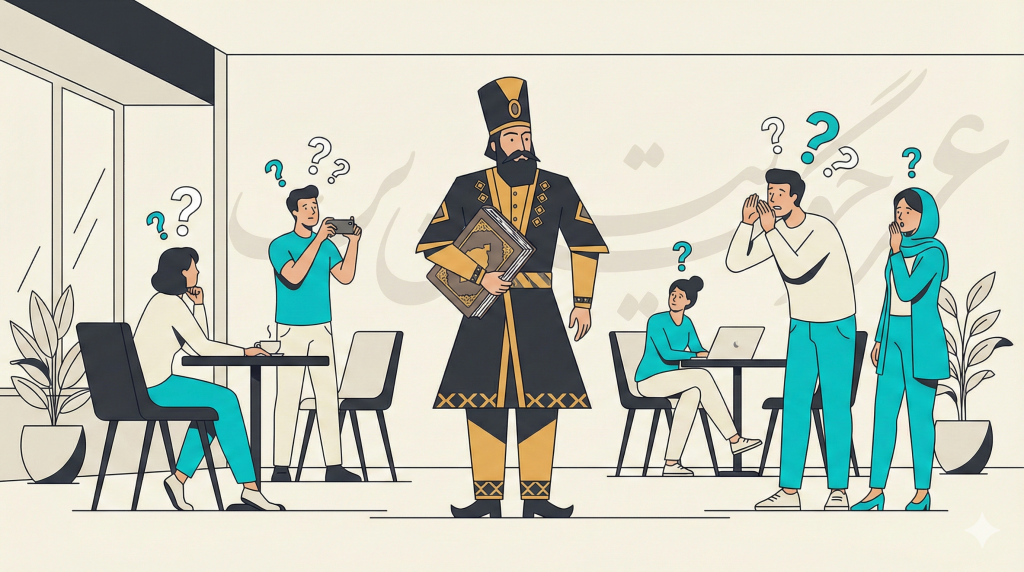
If you were to transcribe a standard, polite conversation between two men in downtown Tehran and hand it to a psychiatrist in New York, he would immediately call the suicide hotline.
“I will sacrifice myself for you.” “No, I will die for you first.” “I want to circle your grave.” “I want to eat your liver.” “May I be the dirt under your feet.”
This isn’t a goth poetry slam. This is two guys deciding who walks through a door first.
I live in Italy now. Italians are famous for being expressive. they talk with their hands, they shout, they love life. But Italian politeness is sane. If an Italian barista gives me a coffee in Milan, I say Grazie mille. He smiles, I smile, we move on. A transaction. Civilized.
In Iran? If I treated a favor with that much lightness, I would be considered a barbarian.
In Farsi, we don’t just “appreciate” people. We offer to ritually slaughter ourselves for their amusement. We volunteer as human shields against their bad luck. Western linguists call these “Self-Abnegation Politeness Strategies.” I call it Emotional Necrophilia.
If you’re learning Persian, you’ve probably memorized the textbook words for “Thank you”. Mersi or Mamnoon. But if you want to understand the soul of the country (and if you want to date an Iranian without accidentally offending them), you need to understand why we are so obsessed with death. And if you’re still stuck on textbook Farsi that makes you sound like a 19th-century poet, this is where the real language begins.
Let’s dissect the Ghorbanat Paradox and the dark art of Persian politeness.
Why We Are So Morbid: The Anthropology of “The Sacrifice”
To understand why I tell my mother “I will die for you” when she passes me the salt, we need some context.
The root word you’ll hear 50 times a day in Iran is Ghorban (قربان). It comes from the Semitic root Q-R-B, meaning “to draw near” (to God). In ancient times. pre-Islamic and early Islamic history. you didn’t just say “thanks.” You proved your loyalty through sacrifice. You slaughtered a sheep, a camel, or a goat to show devotion to a deity or a king. Blood was the currency of loyalty.
Fast forward a few thousand years. We stopped killing camels at every dinner party (bad for the carpet), but the psychology of debt remained.
There’s also the weight of Persian literary tradition. Hafez, Rumi, and Sa’di filled their poetry with lovers who wanted to be annihilated by love. The moth circling the flame until it burns. The nightingale bleeding on the thorn of the rose. These aren’t just metaphors to Iranians. they’re the emotional software we run on. Add centuries of Shia mourning culture, where grief and self-sacrifice are elevated to the highest forms of devotion, and you get a language where “I’ll die for you” is just another way of saying “pass the bread.”
The Zero-Sum Status Game
In a high-hierarchy society like Iran, status is a zero-sum game. For me to raise your status, I must lower mine.
I can’t just say “You are great.” That’s cheap. I must say “You are a king, which implies I am a peasant, and therefore my life is disposable compared to yours.”
Intense? Yes. But in 2026, this has lost its literal blood-soaked meaning and become a verbal tic. the social lubricant of Iranian society. It’s how we acknowledge hierarchy so we can ignore it and be friends. It’s the same instinct behind why Iranians avoid saying “I” directly. you shrink yourself to make others comfortable.
The Glossary of Doom: A User’s Guide to Persian Death Wishes
Okay, let’s get into the street expressions. You need to know these, but you also need to know when to use them. Hearing native speakers say them on Forvo helps you nail the tone. Get it wrong, and you look like a psychopath.
1. Ghorbanet Beram. The Swiss Army Knife
Fingilish: Ghorbanet beram
Script: قربانت بروم
Literal: “May I go and become your sacrifice.”
Actual meaning: “Thank you,” “Goodbye,” “I love you,” “Okay.”
This is the most common phrase in the Persian language after Salam.
Scenario: You buy cigarettes. The shopkeeper gives you change.
You say: Ghorbanet. (Thanks, boss.)
Scenario: You’re hanging up the phone with your aunt.
You say: Ghorbanet, khodahafez. (Die for you, bye.)
It’s so common it has lost its weight. like the American “I’m dead” (meaning: that’s funny). But be careful: it’s informal. Don’t say this to a government official, a professor, or a police officer unless you want a very confusing interrogation.
2. Doret Begardam. The Orbital Mechanics of Love
Fingilish: Doret begardam
Script: دورت بگردم
Literal: “Let me circle around you.”
Actual meaning: “You are adorable,” “I cherish you.”
This is the one that confuses my Italian friends the most. “El, why are you circling people? Are you a shark? Are you a satellite?”
Think about the Kaaba in Mecca. Pilgrims circle it (Tawaf) because it is the center of the spiritual universe. Or think of the moth and the flame. in Persian poetry, the moth (Parvaneh) is the ultimate lover because it circles the flame until it gets too close and is incinerated. When you tell someone Doret begardam, you’re saying: “You are the center of my orbit, and I’m willing to burn up in your atmosphere.”
Usage rules:
High frequency: Grandmothers talking to grandchildren.
Medium frequency: Lovers talking to each other.
Zero frequency: Two straight men watching football. (Don’t do this. It’s weird.)
3. Fadat Sham. The Bodyguard
Fingilish: Fadat sham
Script: فدات شم
Literal: “May I be your ransom/sacrifice.”
Actual meaning: “I appreciate you deeply.”
This is different from Ghorban. Fada implies taking a bullet for someone. It means if Bala (evil, misfortune, calamity) is heading towards you, I’m volunteering to jump in front of it so it hits me instead.
This is the bread and butter of Tarof (Persian etiquette). If someone compliments your shirt, you don’t say “Thanks.” You say: Male shoma (It’s yours. you don’t mean it, but you must offer), fadat sham. You don’t actually have to give them the shirt. But you have to offer to give them the shirt, and offer to die. It’s a dance. Just keep up. For more on navigating Tarof without losing your mind, check out the Mersi hack for saying “no” without starting a war.
4. Marg-e Man?. Weaponized Hospitality
Fingilish: Marg-e man?
Script: مرگ من؟
Literal: “My death?”
Actual meaning: “I swear on my life / Do this for me.”
This is not polite affection; this is emotional blackmail. In Italy, if I offer a guest pizza and they say “No, I’m full,” I say “Okay, more for me.” In Iran, that is illegal.
If a guest refuses fruit, tea, or dinner, you must verify if they’re lying (Tarof) or actually full. You deploy the nuclear option: “Marg-e Elyar bokhor.” (On Elyar’s death, eat this cucumber.)
Now they are trapped. If they don’t eat the cucumber, they are theoretically responsible for my death. Brilliant, manipulative, and essential. but only if you maintain intense eye contact while saying it.
5. Nokaretam / Chakeram. The Bro Code
Fingilish: Nokaretam / Chakeram
Script: نوکرتم / چاکرم
Literal: “I am your servant / I am your slit-open slave.”
Actual meaning: “I got you, bro.”
This is exclusively for the boys. Chaker comes from an old word meaning someone who has torn their collar open in grief or servitude. When your friend picks you up from the airport, you don’t say “Thanks man.” You say: “Chakeretam dadash.” (I am your slave, brother.)
It establishes equality by pretending to be inferior. Paradoxical? Yes. That’s Iran.
Body Horror: Cannibalism and Self-Burials
We’ve covered death. Now let’s cover anatomy. The morbidity of Persian love expressions extends to our internal organs.
Jigarto Bokhoram. The Hannibal Lecter Twist
Fingilish: Jigarto bokhoram
Script: جیگرتو بخورم
Literal: “I want to eat your liver.”
Actual meaning: “You are delicious / adorable / I love you intensely.”
In the West, the heart is the center of emotion. In Persian anatomy, the liver (Jigar) is the seat of deep affection and courage. So, naturally, the most romantic thing you can say to someone is that you want to consume their liver. Say this on a first date in Milan, and the Carabinieri will arrest you. Say it in Tehran, and she’ll blush.
We also use Jigar as a noun: “Che jigari!” (What a liver! = What a hottie.) If you want more ways Iranians weaponize everyday words, you’ll enjoy the vegetable insult guide. because calling someone a potato is an act of war.
Khak Too Saram. The Self-Funeral
Fingilish: Khak too saram
Script: خاک تو سرم
Literal: “Dust on my head.”
Actual meaning: “I should die of embarrassment / I messed up.”
When we mess up, we don’t just say “Oops.” We invoke a funeral. This refers to the ancient practice of pouring grave dirt on your head during mourning.
Dropped my phone? Khak too saram.
Failed my exam? Khak too saram.
Forgot your birthday? Khak too saram.
We live our lives constantly oscillating between offering to die for others (Ghorbanet) and mourning our own stupidity (Khak too saram). It is an emotional rollercoaster.
The Power Dynamics Behind the Simping
So, why do we do this? Is it just low self-esteem? No.
Iran is a high-context culture with a history of absolute monarchy. In such systems, direct language is dangerous. You need layers. You need safety buffers.
When I say Ghorbanet beram, I’m not actually being submissive. I’m indebting you. By lowering myself so drastically, I’m forcing you to treat me with kindness. It’s a reverse power play.
If I claim to be your servant, you are morally obligated to be a benevolent master. If I offer to die for you, you cannot attack me.
It’s a way of controlling the interaction by surrendering control. It’s also about Aberoo (face/honor). If I don’t use these phrases, I look cold, arrogant, and “dry” (Khoshk). In Iran, being dry is a social death sentence. You have to be “warm” (Garm), and warmth requires the vocabulary of sacrifice.
How Not to Embarrass Yourself
Reading this is easy. Using it is hard. Here’s my advice:
Start with “Ghorbanet.” It’s safe. Use it instead of Mersi sometimes. It immediately signals that you understand the culture, not just the grammar.
Avoid “Jigar” at work. It’s too intimate. You don’t want to eat your boss’s liver. That is an HR violation in any country.
Don’t overdo it. If you say “I will die for you” to a taxi driver who is ripping you off, you’re just a simp (or Zan-Zalil. literally “woman-humiliated,” what English speakers call “whipped”). You have to maintain your frame.
Layer it in gradually. If you already know some Farsi slang basics, these death expressions are the next level. They’re what separate the tourist from the local.
Persian is not just a language. It is a role-playing game where everyone is trying to out-polite each other until one person collapses.
Where to Go Next
Now you know why Iranians sound like they’re writing suicide notes every time they buy bread. But knowing these expressions and deploying them. with the right tone, the right timing, the right level of eye contact. are two very different things.
If you want to actually practice these in conversation (and learn the dozens of other expressions that make Persian the most emotionally intense language on Earth), book a trial lesson with me on Preply. I’ll make sure you can say “I’ll die for you” without anyone calling the police.
Dating an Iranian and need the practical guide to all this? Read why Persian love language sounds like a medical emergency. it covers what to say back when your partner calls you their liver. And for the complete guide to Persian romance. from first flirt to meeting the parents. see our Love in Farsi hub. And for the other end of the emotional spectrum, there’s our guide to Iranian curse words (the ones they definitely won’t teach you in class). Or if you want to start with the polite end, try our Persian greetings guide. Heading to Iran soon? Our travel Farsi survival guide has every phrase you need, including how to handle ta’arof in taxis. And if you’re curious how the diaspora keeps these emotional expressions alive, read Between Two Languages: The Iranian Diaspora and Farsi. And for the full picture of how these expressions fit into the broader social code, see our guide to Iranian social customs, humor, and internet culture.