You’re in Seattle, paying something like $1,800–2,300 for a studio in Capitol Hill or South Lake Union, biking through drizzle nine months of the year, and juggling work, traffic on I‑5, and whatever’s left of your social life. Now you’re googling “learning Persian in Seattle” or “learning Farsi in Seattle” on a grey Tuesday, half out of guilt, half out of panic before the next family gathering.
You probably know there are options. The University of Washington has Persian. The Washington Academy of Languages runs Persian on Zoom. Seattle Persian School on the Eastside is there for kids. You have seen random “native Farsi tutor Seattle” ads based in Bellevue or Redmond. The Iranian community in Seattle is here, scattered across the city and the Eastside, not a giant enclave, more like pockets: a few families in Ballard, tech workers in Bellevue, grad students in the U‑District.
But none of that answers the real question in your head: Are any of these going to stop me sounding like a newsreader from 1975 when I talk to my cousins or my partner? And will you have to sit under the silent judgment of some random auntie in a fluorescent‑lit classroom off Highway 520 after work?
This is the gap in most Persian classes Seattle offers: they teach Persian, but not the Farsi you actually need for real conversations. Let’s get specific about what that means for you if you’re serious about learning Persian in Seattle.
Why Most Persian Classes Seattle Offers Miss the Real Needs of Learners
When you search for learning Persian in Seattle, you’re usually not dreaming of reading 12th‑century poetry in Middle Persian. You want to understand your parents when they switch to Farsi mid‑argument, or survive a Nowruz party in Bellevue without freezing every time someone throws slang at you.
Most local learning options simply were not designed for that.
The Ketabi Problem and Why Textbook Persian Misleads Students
In Iranian terms, what you get in many programs is ketabi, the formal, classroom, “bookish” Persian. It is clean, correct, and slightly dead.
For example, a textbook might teach you:
Ketabi:
حالِ شما چطور است؟
hâl‑e shomâ chetor ast? = “How are you?” (very formal)
Real people in Tehran, and honestly, most Iranians in Seattle, will say:
Mohavereh (street Farsi):
چطوری؟ / حالت چطوره؟
chetori? / hâlet chetore? = “How’s it going?”
Or the classic textbook line:
Ketabi:
من به فروشگاه میروم.
man be forushgâh miravam. = “I am going to the store.”
Versus how people actually talk:
Mohavereh:
دارم میرم فروشگاه.
dâram miram forushgâh. = “I’m heading to the store.”
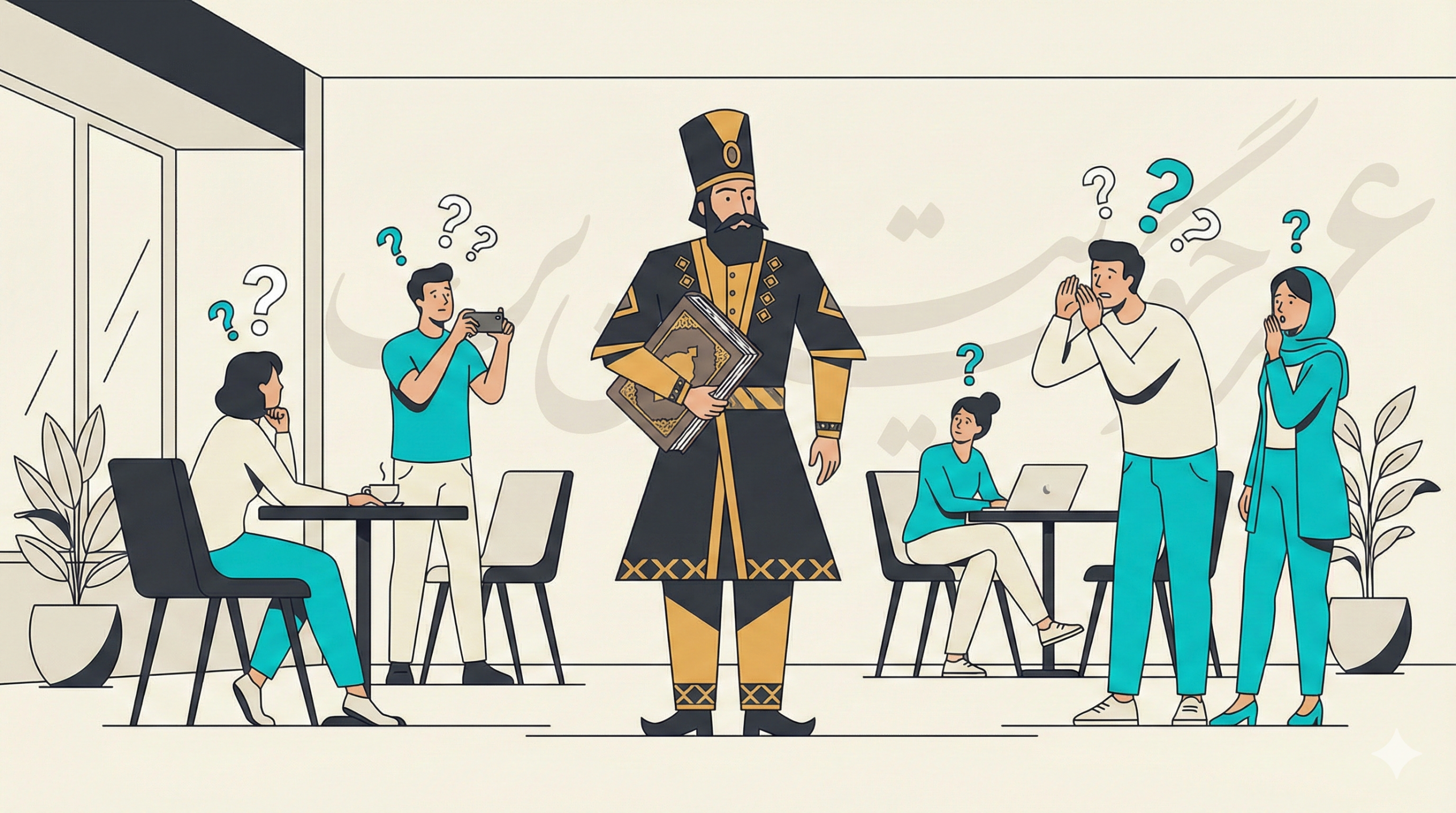
Both are “correct,” but the first one makes you sound like a news anchor from the Shah era who time‑traveled into a Seattle living room. It is not wrong; it is just not how people talk to friends, siblings, or their partner’s family.
In a lot of Seattle programs, especially the academic ones, the teaching materials are from the 1970s–1990s, imported for Islamic Studies students, not for you. You get grammar charts, long reading passages about ancient kings, and very little of the casual, messy, meme‑able Farsi you hear in modern Iranian movies, Instagram, or rap. You walk out able to conjugate verbs in three tenses but unable to follow a simple rant in Tehrani slang. That is the ketabi trap.
How Colloquial Tehrani Persian Changes Everything for Actual Conversations
When Iranians say Fârsi, most of the time they mean the Tehrani‑based colloquial standard, what you hear in current TV series, podcasts, and WhatsApp voice notes. It is what dominates social media and pop culture.
If your goal is:
talking to your partner’s mom in Kirkland,
reconnecting with cousins back in Karaj or Tehran,
or using Farsi with colleagues on an Iran‑focused project,
then Tehrani colloquial is the baseline you need, not some generic formal Persian that only exists in textbooks and news bulletins.
Colloquial Tehrani Farsi changes everything because it shifts the focus from “Is this grammatically perfect?” to “Does this sound like a real human?” Instead of memorizing lists of proverbs, you learn how people actually:
complain about Seattle rent,
gossip about relatives,
flirt, argue, apologize, and do tarof without overdoing it.
Most Seattle classes, even the good ones, do not explicitly say, “We teach Tehrani street Farsi.” Their default is ketabi, maybe with a bit of spoken language sprinkled in based on the teacher’s mood. That is why you can finish multiple levels and still freeze when someone says something as simple as:
اِ امروز خیلی داغونه هوا.
e, emrooz kheili dâghoone havâ.
“Wow, the weather’s a mess today.”
If the class does not center mohavereh from day one, you will always feel like there is a secret, parallel language that everybody knows except you.
What Serious Learners in Seattle Expect but Rarely Receive
People searching for learning Persian in Seattle or looking up “Persian classes Seattle” usually are not casual tourists. You are juggling tech schedules, grad school, nonprofit work, or service jobs, and squeezing this in between clouds and coffee.
Your reasons are specific, and most programs do not bother designing around them.
Heritage Speakers Who Want More Than Childhood Exposure
If you grew up in Bellevue, Shoreline, or Kent with Iranian parents, your Farsi might live in a weird limbo. You understand plenty but answer in English. You can catch the emotional tone of a sentence, but not the slang inside it.
You have maybe tried a weekend Persian school or a community class aimed at kids. The vibe was:
heavy on reading and writing,
light on real adult conversations,
plus a side of Auntie Gaze, comments about your accent, your clothes, your tattoos, your life.
As an adult, you want something different: a space where you can say “I never learned this as a kid” without feeling like you failed Iran. You want explanations of why your parents talk one way, your LA cousins talk another way, and the people in Tehran TikToks sound like a third language.
Most formal programs in Seattle still treat you as a blank beginner or a future literature scholar, not as a heritage speaker with gaps, shame, and a real emotional stake in this.
Partners Preparing for Family Dynamics That Textbooks Never Explain
If you are dating or married to an Iranian in Seattle or on the Eastside, your situation is different again. You do not necessarily need to write essays in Persian. You need to:
survive extended dinners in someone’s apartment in Redmond,
understand jokes that get translated as “oh, never mind, it’s not funny in English,”
handle tarof when everyone is arguing over who pays the bill at a restaurant in Belltown.
Textbook Farsi is almost useless for this. It will not teach you the phrases your partner’s mom uses when she is worried, or the exact slightly passive‑aggressive compliments relatives drop in group settings.
Most Seattle courses will not say a word about family politics, generational slang, or what it actually feels like to be the non‑Iranian partner in that space. You end up memorizing formal greetings while your real pain point, social survival, stays untouched.
Professionals Who Need Persian That Works in High‑Pressure Settings
Seattle also has people who need Farsi because of work: policy researchers dealing with Iran sanctions, journalists covering the diaspora, grad students at UW, NGO staff, even engineers working with Tehran‑based teams from afar. For you, the problem is speed and relevance.
Semester‑long university classes move slowly and often prioritize literature or classical texts. Religious‑oriented programs focus on Quranic or archaic vocabulary. Both are fascinating, just not what you need when your deadline is next quarter, not in five years.
You expect a class that can get you from zero (or rusty) to functioning in meetings, interviews, or fieldwork situations with real, contemporary language. Instead, you are back to memorizing the days of the week like you are in middle school.
So across these three groups, heritage learners, partners, professionals, the pattern in Seattle is the same. There are Persian classes and Farsi tutors in Seattle, but they are rarely designed with you at the center.
The Farsi Learning Options in Seattle, and the Hidden Gaps in Each One
Seattle is not a Farsi desert. There are real options for learning Persian in Seattle, they just come with trade‑offs you should understand before you commit your time, money, and winter energy.
University and Community College Courses That Prioritize Grammar Over Use
The University of Washington offers multi‑year Persian through its Persian and Iranian Studies program. If you are already at UW, that can be a solid way to build a reading foundation. The catch is built into the structure:
it is term‑based and slow,
the focus leans toward literature, history, and formal registers,
you are learning “standard Persian,” not targeted Tehrani street language.
For a heritage speaker or partner, this often feels like using a PhD hammer on a very social nail. You will get good at understanding written texts and formal speech, but you will not necessarily walk out ready to argue about the ending of a Tehran‑set movie or gossip in DMs.
Community colleges in the region do not, as of 2025, widely advertise Persian; if something exists, it is usually a special‑topics course, again, more academic than practical.
Private Tutors Who May Know Persian but Not Pedagogy
If you search around Seattle, Bellevue, and online platforms, you will find private Farsi tutors, “native speakers, flexible hours,” sometimes through services like Seattle Languages International, Wyzant, or other tutor marketplaces. The range is wide. Some tutors are excellent and experienced. Others are just bilingual people trying to improvise lessons.
Typical local rates sit roughly in the $35–60 per hour range for one‑on‑one lessons, depending on experience and whether it is in‑person or online. The hidden gap is methodology. Being a native speaker does not automatically mean they:
know how to build a curriculum around your goals,
understand the difference between teaching heritage versus absolute beginners,
can explain why your ketabi textbook phrase sounds weird in mohavereh.
So you might end up paying Seattle prices to be drilled on verb tables with no clear path to the kind of natural, modern speech you actually want.
Cultural Centers That Offer Immersion Without Structure
On the community side, you have places like Seattle Persian School on the Eastside that focus largely on children and teens, with cultural and language programming around Persian holidays and events. These spaces are great for immersion: you hear Farsi in the hallways, you see Nowruz decorations, you bump into that uncle who insists you should already be fluent.
But adult classes, if they exist, are often:
scheduled at awkward weekend times,
mixed‑level, with no real placement system,
taught in a semi‑volunteer style, passionate but not always structured.
The result is that you get culture and community, but not necessarily a systematic path from where you are now to “I can follow Tehran YouTube and talk like a functioning adult.”
Add Seattle’s reality on top of that, dark at 4:30pm in winter, endless drizzle, long commutes from Seattle to Bellevue or Redmond, and suddenly the idea of dragging yourself to a community center after work starts to feel like another chore, not a support for your identity.
How to Judge Farsi Classes in Seattle Before You Enroll
Before you throw your rainy‑day energy into another course, you can do a quick “Seattle stress test” on any Farsi class, Persian program, or Farsi tutor Seattle has to offer.
Questions That Reveal Whether the Teacher Understands Colloquial Persian
When you talk to a program or tutor, UW, Washington Academy of Languages, a private teacher in Bellevue, whoever, ask very direct questions:
- “Do you explicitly teach Tehrani colloquial (spoken) Farsi, or mainly formal Persian?”
If they say “we teach standard Persian” and cannot explain how they handle slang, fillers, and casual speech, expect a mostly ketabi experience. - “Can you give me an example of how you would teach a phrase in both formal and colloquial forms?”
A teacher who gets it will immediately show you something like chetor ast versus chetori. If they stare blankly or insist “we do not use slang,” that is a red flag. - “What kind of materials do you use?”
If everything is photocopied from an old university textbook, you are looking at 1970s Persian. You want to hear about clips from modern series, Instagram posts, memes, or recent music, things living Iranians actually consume. - “How much time in class is spent actually speaking?”
You are in Seattle. Your time, energy, and emotional bandwidth are limited. If 80 percent of class is silent workbook time, it is not worth your commute, even if the commute is only from your desk to your couch.
Signals That Show the Course Fits Your Identity and Learning Motive
Beyond the language itself, you need to know whether this class will avoid feeding your diglossia shame.
- If you are a heritage learner, ask whether they have taught heritage speakers before, and how they handle students who understand a lot but cannot speak. You are looking for answers like, “We build on what you already know,” not “We will fix your bad habits.”
- If you are a partner of an Iranian, ask whether they cover family dynamics, tarof, and real‑life situations like meeting parents or going to Iranian gatherings in Seattle. If they laugh awkwardly and change the topic back to grammar, that tells you everything.
- If you are a professional, ask how quickly they can get you to functional use. Does the course let you tailor topics like politics, tech, NGO language, or is it stuck on “This is a pen” for three months?
- Most importantly, notice your own body reaction. If imagining that class after a long, dark Seattle workday makes you feel tired and watched, not curious and supported, that course is not built for the version of you who actually lives here.
Why Many Learners in Seattle Advance Faster With Online Persian Instruction
Seattle’s lifestyle already asks a lot from you. Between the cost of living, the long grey season from October to May, and commuting across bridges in rush hour, adding another fixed in‑person commitment can be the thing that quietly kills your motivation.
That is why, for many people interested in learning Persian in Seattle or searching “Persian classes Seattle,” the most realistic option is actually online, not as a compromise, but as a way to finally get what local programs cannot offer.
Access to Native Dialects That Local Programs Cannot Provide
Local institutions tend to default to formal, somewhat de‑personalized Persian. With online lessons, you can choose a tutor who actually speaks Tehrani street Farsi, who grew up with the slang and cultural references you hear in today’s Iranian media.
Instead of hoping your Seattle‑area tutor happens to be up to date, you can explicitly look for someone who:
corrects you when you sound like a textbook but offers a natural alternative,
explains why a phrase sounds “too Afghan,” “too old,” or “too religious” for everyday use,
brings you clips, memes, and conversations taken from current Tehran life.
In practice, that means your Farsi starts to feel like a living tool, not an academic subject you once took in a cold classroom near the U‑District.
Flexible Learning Systems That Match Real‑World Stakes
Seattle is full of time‑poor people: tech workers in South Lake Union, grad students at UW, service workers doing late shifts, nonprofit staff burning out quietly. A rigid Tuesday–Thursday course at 6pm, across town, in winter, is the perfect recipe for drop‑out.
Online lessons cut out all the friction. No bus transfer in the rain from Ballard. No crawling on I‑5 from Tacoma or Lynnwood. You log in from your couch, hoodie on, tea in hand, and put your limited energy into speaking, not commuting.
Financially, it also often makes more sense. Many good online tutors sit in the $20–40 per hour range, sometimes less, which can undercut Seattle‑area private rates once you factor in transit and parking. Most importantly, a good online system can be personalized around your real stakes.
If you tell me, “I have to talk to my partner’s family by Nowruz” or “my research trip is in six months,” I can design around that, drilling you on the phrases, situations, and cultural landmines you are actually going to face, not on abstract grammar.
You do not need another source of guilt or another fluorescent classroom where you feel like the worst student. You need something that slots into your life in Seattle as it is now: expensive, rainy, intense, but still yours.
Frequently Asked Questions about Learning Persian in Seattle
What should I look for when choosing Persian classes in Seattle?
Ask whether they explicitly teach Tehrani colloquial Farsi, not just formal “standard Persian.” Check what materials they use, such as modern shows, memes, and voice notes instead of only old textbooks, and how much time you actually spend speaking. Make sure the course is designed around your goals as a heritage learner, partner, or professional in the Seattle and Eastside Iranian community.
Why do many Persian classes Seattle offers feel too formal or outdated?
A lot of local programs rely on older, academic Persian materials aimed at literature or Islamic Studies students. They emphasize ketabi (bookish) language, grammar charts, and classical texts. That helps with reading and formal speech, but leaves you struggling with everyday Tehrani slang, family conversations, and social situations in the Seattle Iranian community.
What is Tehrani colloquial Farsi and why does it matter for Seattle learners?
Tehrani colloquial (mohavereh) is the modern spoken Farsi you hear in today’s Iranian series, social media, and everyday conversations. For most Seattle learners, including heritage speakers, partners, and professionals, it is the variety they will actually use with family, friends, and colleagues, so centering it makes you sound natural instead of like a textbook newsreader.
Are online Farsi classes better than local in‑person options in Seattle?
For many people learning Persian in Seattle while juggling commutes, weather, and workload, online Farsi classes are more realistic. They cut out travel, often cost less than local private tutoring, and let you choose a tutor who actively teaches up‑to‑date Tehrani street Farsi using real media, tailored to your deadlines and specific communication goals.
How much do Farsi classes in Seattle typically cost?
Prices vary by format. Private local tutors around Seattle and the Eastside often charge roughly $35–60 per hour. University courses are paid through tuition rather than per lesson. Online one‑on‑one Farsi classes with teachers abroad can be more affordable, commonly in the $20–40 per hour range, sometimes lower in package plans.
How long does it take to become conversational in Farsi if I study in Seattle?
If you focus on Tehrani colloquial Farsi, practice speaking regularly, and take one to two targeted lessons per week, many motivated learners can handle basic everyday conversations in 4–6 months. Heritage speakers with passive understanding often progress faster, while complete beginners may need closer to 9–12 months for comfortable small talk.