You’re in Victoria, probably paying more than you’d like for a basement suite in Fernwood, James Bay, or somewhere along Cook Street. It’s February, it’s dark by 4:30, the wind off the Inner Harbour cuts straight through your jacket, and the idea of bussing across town in the rain for a Farsi night class feels… brutal.
On top of that, you’ve already tried the “proper” route. Maybe a formal class at UVic Continuing Studies, maybe a heritage-style setup where everyone spoke to you like you were still eight years old. You walked out able to read the alphabet and recite some poetry, but when you put on Shab-e Yalda clips or Ho3ein on Spotify, it’s like a different language. You can order ghormeh sabzi in Vancouver on a weekend trip, but you can’t follow your cousin’s Telegram voice notes.
If you’re googling “Farsi classes in Victoria”, there’s usually a mix of guilt and curiosity behind it. You’re proud of being Iranian or connected to Iran, but you’re tired of sounding like a BBC announcer from 1970 every time you try to speak. And you definitely don’t want to sit in a fluorescent-lit classroom explaining your pronunciation to an auntie who’s mentally scoring your life choices.
So let’s map out what actually exists in Victoria, where the gaps are, and how to build a Farsi plan that fits your real life, not some imaginary student on a poster.
Why Most Farsi Classes in Victoria. Miss the Real Needs of Learners
Victoria isn’t Tehran or Toronto. The Iranian community exists here, but it’s small and scattered, students around UVic, families in Saanich or Gordon Head, a few professionals downtown. That means your options for Farsi classes are limited, and most of them lean heavily toward textbook-style, formal instruction.
The Ketabi Problem and Why Textbook Persian Misleads Students
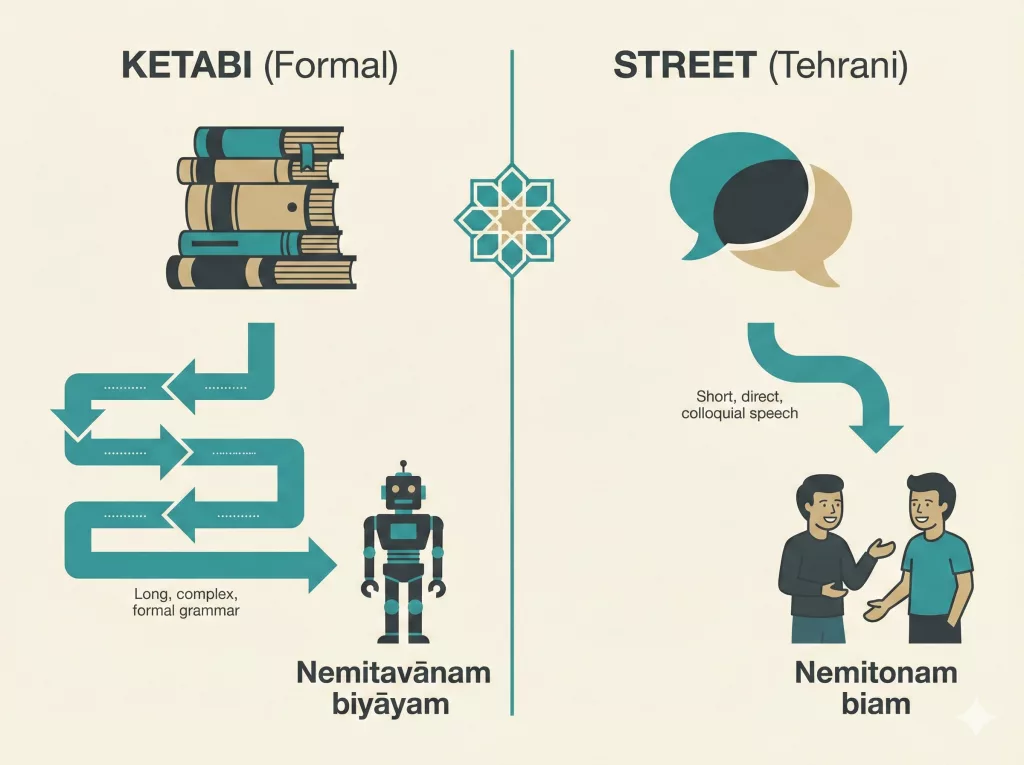
Most structured Farsi classes in Victoria, especially the ones linked to universities or generic language companies, teach what we call ketābi: formal, written-style Persian. It’s great if you want to read news or classical poetry. It’s terrible if you want to understand a meme on Iranian Twitter or talk to your cousins in Karaj.
A classic example:
- Ketabi / textbook style:
“حال شما چطور است؟”
Hāl-e shomā chetor ast? – “How are you?” - Street / Tehrani style:
“چطوری؟” / “چطوری خوبی؟”
Chetori? / Chetori, khobi? – “How’s it going?”
Both are “correct.” But if you walk into a party in Esquimalt full of second‑gen Iranians and drop hāl-e shomā chetor ast?, you’ll sound like you teleported from a state TV newscast. That’s the ketabi problem: it trains you to speak like a textbook, not like a real person.
Another one:
- Ketabi:
“من نمیتوانم بیایم.”
Man nemitavānam biyāyam. – “I cannot come.” - Street:
“نمیتونم بیام.”
Nemitunam biam. – “I can’t come.”
That tiny shift, nemitavānam biyāyam to nemitonam biam, is exactly where most Victoria courses stop short. They show you the formal form, maybe mention “people say it faster,” and then move right back to drilling grammar tables.
If you already feel insecure about your Farsi, ketabi makes it worse. You end up with this weird diglossia: you can read headlines and recite Hafez, but you freeze when someone casually asks, “کجایی تو؟” (kojāyi to? – where are you?).
How Colloquial Tehrani Persian Changes Everything for Actual Conversations
For anyone in Victoria whose real-life use of Persian involves family, friends, partners, or media, the target isn’t “generic Persian.” It’s much closer to Tehrani colloquial, the accent and slang you hear in:
- Modern series on Aparat or YouTube
- Iranian stand‑up clips on Instagram
- Rap, pop, and everyday podcasts
Switching focus to mahāvere-i (conversational) Tehrani Persian does a few things for you:
First, it reduces shame. Instead of being corrected for not saying nemitavānam, you’re praised for saying nemitonam naturally. You’re not aiming for some fossilized standard: you’re speaking how people under 40 actually talk in Tehran.
Second, it makes media suddenly transparent. That moment when you realize “مرسی” (mersi – thanks), “باشه” (bāshe – ok), and “الان” (al’ān – now) are everywhere, and you can actually hear them, changes your relationship with the language. Watching a movie becomes practice, not punishment.
Third, it matches your social reality in Victoria. When you take the ferry to Vancouver and end up at an Iranian party in North Van, nobody is evaluating you on your ability to read Ferdowsi. They just want to know if you can keep up with “جوک” (jok – jokes) and “فاز” (fāz – vibe/mood).
Most local classes here never reach that register. They stop at “polite, correct Persian” and leave you stranded the minute someone drops slang or switches speed. That’s the core mismatch: your life is informal and hybrid: the teaching is formal and stuck in 1975.
What Serious Learners in Victoria. Expect but Rarely Receive
People who search “Farsi classes in Victoria” aren’t all the same, but you see the same patterns again and again, heritage guilt, relationship pressure, and professional stakes. The problem is that most courses treat everyone like a generic beginner.
Heritage Speakers Who Want More Than Childhood Exposure
If you grew up in Saanich or Langford hearing Farsi at home but answering in English, you’re in that weird in‑between space. You understand a lot, you can maybe say basic things, but your grammar is shaky and your accent feels off next to your parents.
What you actually need is:
- Someone who won’t treat you like a total beginner or like a fluent speaker
- A space where Diglossia Shame is normal, not a flaw
- Structured help converting passive understanding into active speech
Instead, heritage learners in Victoria often get dropped into beginner classes that start with the alphabet, as if you haven’t spent your whole life half-understanding family arguments. Or they get pushed into heritage-style weekend schools that are really built for kids, with moral pressure instead of adult pedagogy.
Partners Preparing for Family Dynamics That Textbooks Never Explain
Then there are the people dating or married to Iranians, maybe your partner is from Tehran, maybe their family is in Richmond or Burnaby and you visit a lot. You’re not trying to write essays. You’re trying to:
- Survive Nowruz lunches without getting lost
- Understand your mother‑in‑law’s tone when she says “زحمت کشیدی” (zahmat keshidi – you went to trouble)
- Decode tarof so you know when “no, no, you don’t have to” means “actually, please do”
Most Farsi classes in Victoria are completely unprepared for that. They teach you how to say “This is a book” long before they explain what happens when someone insists “نه، نه، قابل نداره” (na, na, ghābel nadāre – it’s nothing / don’t worry about it) while obviously caring a lot.
You end up with nice grades, a textbook, and zero idea how to behave at a family dinner.
Professionals Who Need Persian That Works in High Pressure Settings
Victoria also quietly attracts diplomats, public servants, academics, and NGO folks who deal with Iran or the region. If that’s you, you don’t have time to waste on courses that are essentially “Persian for poetry appreciation.”
You need:
- Listening skills good enough to handle different registers on Iranian media
- Core vocabulary around politics, society, and daily life, not just fruit and classroom objects
- A clear sense of when to use formal vs colloquial speech
Some university-style options in and around Victoria focus almost entirely on classical texts, grammar, and reading. Useful for research, yes. But if you’re jumping on calls with Farsi speakers, they won’t care if you can analyze Hafez: they’ll care if you can follow fast, informal speech and respond without freezing.
Serious learners in all three groups expect modern, communicative teaching and real-world language. Victoria’s current options only partly deliver that, if at all.
The Farsi Learning Options in Victoria., and the Hidden Gaps in Each One
As of 2025, Victoria doesn’t have a dense, visible “Little Iran” district. The Farsi learning landscape is thin and a bit fragmented. Here’s what actually exists, and what’s missing.
University and Community College Courses That Prioritize Grammar Over Use
The University of Victoria has offered introductory Persian/Farsi through Continuing Studies in the past, usually an evening, non‑credit Persian Level 1 type course aimed at beginners. The structure is pretty standard:
You meet once a week on campus, you learn the alphabet, basic structures, some cultural notes, and you often get a heavy dose of formal language: polite introductions, reading simple texts, maybe a poem or proverb. It’s legitimate, it’s real Persian, and the instructors are usually knowledgeable.
But the underlying model is academic. Semesters, assignments, grammar explanations, written tests. If you’re juggling work downtown or out in Westshore, commuting to UVic in the dark, rainy months is already a hit. Doing that for a course that still leaves you unable to understand Iranian TikToks feels like a rough trade‑off.
Community colleges in Greater Victoria don’t, as far as I can verify in 2025, offer robust, ongoing Persian programs. If they do list a class, it tends to be short‑term and introductory, with the same grammar‑heavy focus.
Private Tutors Who May Know Persian but Not Pedagogy
You’ll also see companies like Language Trainers or Listen & Learn advertising Farsi classes in Victoria. They usually send a tutor to your home, office, or a café, or arrange lessons online. Prices listed for Persian start around the high CA$20s to CA$30+ per hour, depending on package and group size.
These setups can be helpful if you get lucky with a good teacher. But there are two big unknowns:
First, teaching quality varies wildly. A lot of tutors are simply native speakers with no formal training in how to teach a less-commonly-taught language to adults. You might spend ten lessons chatting and picking up random phrases, but with no structure, no clear path from “I know words” to “I can hold a conversation under pressure.”
Second, most of these services still lean on standard, dated materials. Think photocopied PDFs that start with man Irāni hastam and never touch contemporary slang, Tarof dynamics, or the way Farsi switches registers mid‑sentence.
Cultural Centers That Offer Immersion Without Structure
Victoria has some multicultural and community organizations, but as of 2025 I couldn’t find evidence of a large, formal Iranian cultural center consistently offering structured Persian classes for adults.
What you might find instead are:
- Occasional cultural events, Nowruz celebrations, or language meetups
These can be amazing for exposure and community, but they’re not a curriculum. You might pick up phrases, hear different accents, and feel more connected, but if you already struggle with speaking, being thrown into an all‑Farsi room without guidance can actually increase your anxiety.
That’s the pattern across options in Victoria: each one gives you something, credentials, contact with native speakers, community energy, but very few give you a clear, shame‑free path to talking like the people you actually want to understand.
How to Judge a Farsi Class in Victoria. Before You Enroll
If you’re going to spend your money and your limited winter energy on Farsi classes in Victoria, you should know what you’re walking into before you sign up. A quick email, trial lesson, or phone call can tell you a lot, if you ask the right things.
Questions That Reveal Whether the Teacher Understands Colloquial Persian
You don’t need to interrogate anyone, but you are allowed to interview them a bit. Try questions like:
Ask how they handle formal vs informal language. If they say, “We start with correct Persian first, and maybe later you can learn slang,” that’s a red flag. You want someone who integrates Tehrani casual speech from the beginning, even if the focus is polite language.
Ask whether they use audio and video from contemporary Iran, series, YouTube clips, interviews, or just textbooks and handouts. If all their examples are written and literary, you’re going to end up with beautiful grammar and no ear.
Ask what they do in the first three lessons. If the answer is “alphabet, more alphabet, reading simple words,” and you’re heritage or relationship‑motivated, you may get bored and drop out. A good teacher will balance script with immediate speaking wins, even if that means using transliteration early on.
Signals That Show the Course Fits Your Identity and Learning Motive
Beyond language style, you also need to feel like you can show up as yourself. For a lot of second‑gen or mixed‑background learners, this is where the Auntie Gaze hits hardest.
If you’re queer, non‑traditional, or just living a very non‑”ideal child” life in Victoria, pay attention to how the teacher talks about Iran and Iranians. Do they lean on clichés and moralism, or can they discuss modern culture, politics, and everyday realities without lecturing you?
If you’re a partner of an Iranian, ask directly: “Will we cover Tarof and family dynamics?” If they laugh it off or reduce it to “Iranians are just very polite,” they’re missing 80% of the story.
If you’re a professional, ask how they handle register. Can they explain when you’d say “تشریف بیاورید” (tashrif biāvarid – please come, very formal) versus “بیا تو” (biā tu – come in), and how that shifts between an embassy reception in Ottawa and a Zoom call with activists in Tehran?
A solid Farsi class, online or in person, should make you feel seen, not squeezed into some imaginary “ideal learner” mold.
Why Many Learners in Victoria. Advance Faster With Online Persian Instruction
Victoria’s geography and lifestyle quietly push you toward online learning, even if you started this search hoping for something local and in-person.
Think about a typical weeknight in November. It’s dark, raining sideways, the wind is throwing branches around on Shelbourne or Douglas, and you’re supposed to bus 40 minutes to UVic or drive from Colwood to a tutor’s living room. That’s on top of work, maybe kids, definitely fatigue.
Access to Native Dialects That Local Programs Cannot Provide
Because the local Iranian population is relatively small and scattered, your in‑person options for Tehrani street Farsi in Victoria are extremely limited. Even when you find a native speaker, they might be from a completely different region or focused on classical/Islamic‑studies Persian.
Online, you can be picky. You can choose a tutor who:
- Actually speaks the Tehran accent you hear in modern media
- Is comfortable teaching slang, Tarof, and cultural nuance, not just grammar
Practically, this means your listening skills grow in the direction you care about. Instead of training your ear on slow, careful classroom speech, you’re practicing with someone who sounds like your cousins’ Instagram stories.
Flexible Learning Systems That Match Real World Stakes
The other big advantage is logistical, and in a city like Victoria, with long, grey winters and high housing costs, logistics matter.
Online lessons cut out:
- Commute time in bad weather
- Transit costs or parking
- The mental overhead of showing up somewhere after a long day
You can finish work, make tea, open your laptop, and be in “Tehran mode” in 30 seconds. No soaking‑wet bus rides to Gordon Head, no trying to find a café table that isn’t crowded.
Pedagogically, good online teaching can also outpace local classes. Modern platforms let you:
- Record sessions and rewatch tricky explanations
- Get custom decks and exercises tailored to your weak spots
- Mix structured conversation with explicit grammar only when you need it
If you’re serious about fixing your Farsi, whether for family, identity, or career, this combination of right dialect + flexible schedule is often what keeps you going past week three.
I teach Tehrani street Farsi online because I’m in a different country and it works. If you’re in Victoria and tired of dragging yourself through rain and dark just to conjugate verbs under fluorescent lights, we can build a Farsi routine that fits your actual life instead of fighting it.
You found this article by searching. That’s how I teach, accessible, no gatekeeping, actual street Persian from someone who grew up speaking it in Tehran:
https://preply.in/ELYAR6EN18342704101?ts=17640787
Frequently Asked Questions about Farsi Classes in Victoria
What Farsi classes in Victoria are currently available for adult learners?
In Victoria, most structured Farsi options are UVic Continuing Studies–style evening courses, occasional short community‑college offerings, and private tutors arranged through language companies. These usually focus on formal, textbook Persian and meet once a week, which can be hard to sustain during dark, rainy months or with full‑time work.
Why do most Farsi classes in Victoria focus on textbook or ‘ketabi’ Persian?
University and generic language‑school programs tend to prioritize reading and grammar, so they default to formal, written Persian (ketabi). This works for poetry or news but leaves you struggling with fast, colloquial speech, memes, and real family conversations, especially if you mostly interact with under‑40 Iranians or watch modern Iranian media.
How can I choose the right Farsi class in Victoria for my needs?
Before enrolling, ask teachers how they handle formal vs colloquial Tehrani Persian, what they cover in the first three lessons, and whether they use contemporary audio and video. Also check if they understand your situation—heritage learner, partner of an Iranian, or professional—so you’re not pushed into a generic beginner track.
Are online Farsi lessons better than local in‑person classes in Victoria?
For many learners, yes. Victoria’s small, scattered Iranian community limits access to modern Tehrani speech in person. Online, you can choose native Tehrani tutors, focus on slang and everyday conversation, avoid long commutes in winter, record sessions, and get materials tailored to your goals and schedule.
Can beginners start directly with colloquial Tehrani Farsi, or should they learn formal Persian first?
Beginners can absolutely start with colloquial Tehrani Farsi as long as the course still gives you core grammar and clear pronunciation. Learning everyday structures like “nemitonam biam” alongside their formal equivalents makes it easier to understand modern media, family speech, and social situations while still recognizing more formal written Persian later.