You’re in Cincinnati, juggling work, Kroger runs, and that yearly drive on I‑71 to visit family. Maybe you’re in Clifton near UC, or out in Mason or West Chester where the good schools and endless strip malls live. And somewhere between grey winter skies over the Ohio River and another random Bengals conversation at the office, you opened a tab and typed “Farsi classes in Cincinnati.”
If you’re honest, it’s not because you’re dying to sit in a fluorescent classroom after work. It’s guilt. Your parents or in‑laws switch to Persian at family gatherings and you catch maybe 40%. You tried Duolingo or one stiff textbook class and ended up sounding like a 1970s newsreader. Meanwhile, your cousins in Tehran are sending you memes in fast Tehrani slang and you’re stuck on lesson two: “This is a carpet.”
Cincinnati isn’t LA or Toronto. There’s a small Iranian presence, some families in Mason/West Chester, a few grad students in Clifton, an occasional Nowruz event, but it’s scattered. So your options are either driving to the one Persian event across town, or signing up for some “Oriental languages” course that worships Rumi but doesn’t teach you how to order kebab without sounding robotic.
You don’t need another chore. You need a Farsi plan that actually fits a Midwestern routine and gives you the street Farsi people use in Tehran in 2025, not in textbooks from 1975. Let’s map out what that looks like in Cincinnati, realistically.
Why Most Farsi Classes in Cincinnati Miss the Real Needs of Learners
If you’ve already tried any kind of Persian class, maybe at a university, maybe through a generic language company, you probably felt that weird disconnect: you’re learning, but you’re not actually talking.
That’s not you. That’s the Ketabi problem.
The Ketabi Problem and Why Textbook Persian Misleads Students
Most formal Farsi classes in the US, including the ones you might find from language training companies in Cincinnati, are built around کتابی (ketabi – textbook, formal) Persian. It’s correct, it’s polite, and it’s how news anchors speak. But Iranians don’t talk to each other like that in everyday life.
Take a simple question like “How are you?”
- Ketabi: حالِ شما چطور است؟
hāl‑e shomā chetor ast? – “How are you?” (formal, very textbook) - Street Tehrani: چطوری؟ / خوبی؟
chetori? / khobi? – “How’s it going?”
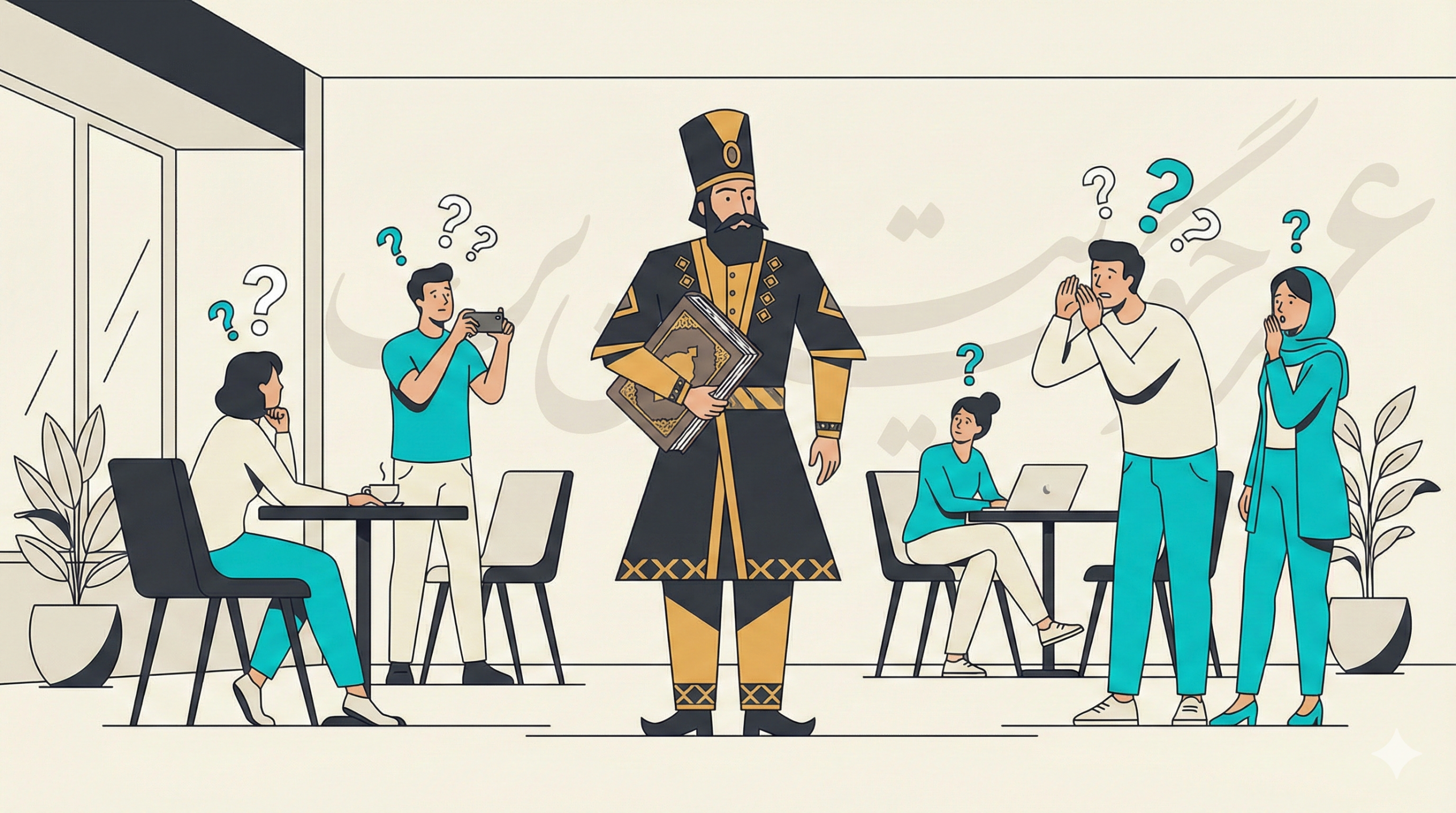
If you walk into a gathering in Mason and greet your younger cousins with hāl‑e shomā chetor ast? they’ll probably laugh and tell you you sound like national TV. The same happens if you talk to a friend in Tehran over video call, you’ll feel this invisible wall between “what I learned” and “how people actually speak.”
The other issue is time. A lot of official courses in the US still use grammar‑translation methods. Week 5, you’re conjugating obscure verb forms: week 10, you still can’t handle a basic phone call. If you’re working or doing grad school in Clifton, your brain is already fried, you’re not going to survive a slow, theory‑heavy class built for retired hobbyists.
How Colloquial Tehrani Persian Changes Everything for Actual Conversations
Now switch perspective. Imagine you learn محاورهای (mahavereh – conversational/street) Tehrani Persian from day one.
Instead of memorizing “I cannot come to the party” as:
- Ketabi: من نمیتوانم به مهمانی بیایم.
man nemitavānam be mehmāni biyāyam.
You learn the way people actually say it:
- Street Tehrani: نمیتونم بیام مهمونی.
nemitunam biyām mehmuni. – “I can’t come to the party.”
Same meaning. Half the stress. And when your aunt in West Chester texts you «پس چرا نمیای مهمونی؟» (pas cherā nemiyāy mehmuni? – “So why aren’t you coming to the party?”), you’ll recognize it instantly instead of mentally translating into your textbook version.
For someone in Cincinnati, that switch from Ketabi to Tehrani isn’t just linguistic. It’s emotional. It’s the difference between:
- answering your parents in English because Farsi feels heavy and unnatural, vs.
- slipping between languages without feeling fake or “not Iranian enough.”
Most local or generic programs simply aren’t built for that. They’re built to prove you can read poetry from 900 years ago, not help you decode a stand‑up clip from Tehran or flirt properly over Instagram DMs.
What Serious Learners in Cincinnati Expect but Rarely Receive
People who search for “Farsi classes in Cincinnati” are not random. You’re usually carrying some heavy mix of pride, insecurity, and real‑life stakes.
Heritage Speakers Who Want More Than Childhood Exposure
If you grew up in Sharonville, Blue Ash, or another Cincinnati suburb with Iranian parents, your childhood probably sounded like this: they spoke Farsi to you, you answered in English. You get basic phrases, you can catch the vibe at Nowruz, but when it’s time to speak, anxiety hits.
You want a class that:
- doesn’t treat you like a total beginner, and
- doesn’t shame you for not being “properly” Iranian.
Most heritage‑style classes linked to cultural or religious centers focus on kids, not adults, and they often double as identity bootcamps: read this poem, memorize this proverb, write this dictation. For a 30‑year‑old software engineer in Over‑the‑Rhine, that’s not it. You need a de‑shaming, adult space where it’s fine to forget words and ask embarrassing questions about Tarof.
Partners Preparing for Family Dynamics That Textbooks Never Explain
A big chunk of learners in smaller US cities are relationship learners. You’re dating or married to an Iranian from Tehran, Karaj, or Shiraz, and you’re tired of nodding through dinners in West Chester pretending you follow the conversation.
Your needs are brutally practical: what do I say when I walk into the house? How do I politely refuse more food without offending anyone? What does it mean when your mother‑in‑law says «قربونت برم» (ghorboonet beram – literally “let me sacrifice myself for you,” emotionally “you’re sweet”)?
No Cincinnati‑area university syllabus is going to explain why your partner’s friends say دمت گرم (damet garm – “you’re awesome”) after a favor, or why everyone keeps insisting «بفرما» (befarmā – “please, go ahead”) even when they don’t really mean it. But that’s the stuff that will make or break how comfortable you feel in that living room.
Professionals Who Need Persian That Works in High Pressure Settings
Then there are the professionals: NGO workers with Iran‑related projects, journalists in the region, academics at UC working on Iranian politics, or maybe someone in Downtown Cincinnati dealing with Iranian clients.
For you, time is money. You don’t care about perfect calligraphy. You need to:
- survive meetings with a mix of English and Farsi,
- catch key words in phone calls, and
- understand when someone is being direct vs. polite vs. passive‑aggressive (very Persian art form).
A slow, literature‑heavy evening course won’t keep up with your deadlines. You need targeted, high‑impact sessions, with transcripts from real news clips, WhatsApp voice notes, actual emails, not just “Unit 3: In the Bazaar.”
Across all these groups, the pattern in Cincinnati is the same: you expect modern, flexible, Tehran‑aware teaching. You usually get something designed for a completely different era and audience.
The Farsi Learning Options in Cincinnati, and the Hidden Gaps in Each One
Cincinnati isn’t totally empty when it comes to Persian, but the map is patchy. And the gaps matter.
University and Community College Courses That Prioritize Grammar Over Use
As of 2025, I couldn’t find a full Persian language program at the University of Cincinnati or local community colleges like Cincinnati State. UC focuses more on other languages: Persian sometimes appears in course catalogs in the context of Middle East or Islamic studies, usually as culture or literature modules taught in English.
Some national language training companies advertise Farsi courses “in Cincinnati”, often meaning they can send a teacher to your company, or set up an online class tied to the Cincinnati market. These usually lean academic: structured, curriculum‑driven, and heavy on reading/writing.
Strength: if you’re the academic type, you might enjoy formal grammar, writing practice, and the credibility of a syllabus.
Problem: for most people actually searching “Farsi classes in Cincinnati,” you don’t need another GPA. You need to not freeze when your uncle in Tehran calls.
Private Tutors Who May Know Persian but Not Pedagogy
If you search around, you’ll see private tutors on global platforms (Preply, italki, etc.) and sometimes local classifieds claiming they’re “Farsi tutors in Cincinnati.” In reality, most of them teach online, not at a local cafe in Over‑the‑Rhine.
Rates in the US market for Persian tutors with no specific training usually hover around $20–40 per hour as of 2025. Some may be native speakers living in the area, some might be abroad.
The catch: being a native speaker isn’t the same as being a good teacher. A lot of heritage tutors default to how they were taught, grammar drilling, memorization, zero structure for adult learners with jobs. You end up paying to be corrected, not actually guided.
Also, most profiles proudly say they teach “formal Farsi” and bring in poetry. That’s great if your goal is to read Hafez. It’s less great if you just want to understand Iranian rap, comedy, or your cousin’s Instagram captions.
Cultural Centers That Offer Immersion Without Structure
Cincinnati has a modest but real Iranian community, often gathering through groups like the Persian American Cultural Society of Cincinnati (or similarly named associations that organize Nowruz, Yalda, and cultural nights). Events are often held in or around Mason and West Chester, where many families live.
These spaces can be gold if you want immersion, hearing Persian in the wild, tasting home‑style food, seeing kids switching between languages. Sometimes they run Farsi classes, mainly for children, occasionally for adults.
The upside is vibe: it’s the closest you’ll get to an Iranian living room in Cincinnati. But there are three issues for someone like you:
- The Auntie Gaze. If you’re a heritage learner, you already know this. You say one sentence, three aunties correct you simultaneously, then switch back to Persian at light speed. You leave feeling more ashamed than inspired.
- Kid‑first curriculum. Many community classes are built for 8‑year‑olds: alphabet posters, simple stories, no serious space for adult conversations about work, relationships, politics, or identity.
- Lack of pedagogy. Volunteers are often lovely, but they’re parents, engineers, doctors, not trained language teachers. You get plenty of culture, not much intentional, level‑based progression.
So Cincinnati does give you pockets of Persian. But if you want serious, structured, modern Farsi without the guilt or the drive up I‑75 in January slush, you quickly run into limits.
How to Judge a Farsi Class in Cincinnati Before You Enroll
Since the local landscape is messy, you need a filter. Before you put down money or lock yourself into a semester, you can test whether a class or tutor actually fits you.
Questions That Reveal Whether the Teacher Understands Colloquial Persian
Instead of asking, “Do you teach beginners?” ask things like:
- “Do you teach Tehrani colloquial Persian or mostly formal Ketabi Persian?” If they say “Oh, it’s all the same,” that’s a red flag. A good teacher should clearly distinguish محاورهای vs کتابی and explain when each is used.
- “Can you show me how you’d teach the difference between ‘I cannot come to the party’ in formal and in everyday speech?” If they can’t quickly give something like nemitunam biyām mehmuni versus the formal version, they probably don’t emphasize real‑life speech.
- “How soon will I be able to have a basic conversation about my life?” If the answer is somewhere after “we finish the alphabet and grammar foundation in a few months,” that’s another red flag.
You want someone who treats conversation as the spine of the course, not a bonus at the end.
Signals That Show the Course Fits Your Identity and Learning Motive
Cincinnati’s Iranian scene is small enough that you might bump into the same people at Kroger, the cultural center, and class. So the emotional fit matters.
If you’re a heritage learner, check whether the teacher:
- makes it explicit that mixing English and Farsi is allowed at the beginning,
- expects you to already know how to read/write, or is willing to separate “speaking confidence” from “literacy,” and
- understands that you’re not “starting from zero,” you’re reorganizing messy, half‑remembered input.
If you’re a partner of an Iranian, look for:
- content built around family dynamics: visiting, Tarof, in‑law politics, WhatsApp groups,
- zero pressure to “perform” in front of older Iranians, and
- acknowledgement of the emotional side, feeling left out at the dinner table, or scared of saying something wrong.
If you’re a professional, ask directly for:
- sector‑specific materials (news articles, policy briefs, videos),
- a clear timeline: “In three months you should comfortably handle X situations,” and
- flexibility for your schedule, rescheduling when work blows up.
Any serious teacher, online or local, should be able to answer these without giving you brochure talk. If they can’t, you’ll likely end up in the exact class you’re trying to avoid: formal, slow, slightly guilt‑inducing.
Why Many Learners in Cincinnati Advance Faster With Online Persian Instruction
When you live in Cincinnati, your life is already a triangle of home–work–Target or home–campus–Kroger. Adding a weekly drive to a random classroom in Mason or Blue Ash in February snow just to be drilled on verb tables? That’s pain you don’t need.
For a lot of learners here, online Tehrani Farsi ends up being the only option that’s both realistic and effective.
Access to Native Dialects That Local Programs Cannot Provide
Because there’s no major Persian department at UC and only a small Iranian community, your chances of finding a local teacher who:
- is from Tehran,
- understands 2025 slang, memes, and pop culture, and
- has actual language‑teaching training
are pretty low.
Online, you can be in Over‑the‑Rhine or Covington and spend an hour face‑to‑face with someone who grew up in Tehran and teaches with a clear method. Prices internationally range widely, but it’s common to find serious, experienced tutors around $18–35/hour, which often beats corporate “in‑person” options once you factor in gas, parking, and time.
And because it’s online, you’re not stuck with whoever happens to live within 30 miles of Fountain Square. You can pick someone whose accent, vibe, and approach actually match your goals.
Flexible Learning Systems That Match Real World Stakes
Cincinnati has real seasons. There’s that heavy, humid summer, then long, grey weeks where it’s dark by 5 pm and the last thing you want is to trek up I‑71 after work. This is exactly when most in‑person courses expect you to show up.
With online lessons, you can:
- take a 60‑minute class from your couch in Hyde Park after dinner,
- squeeze in 30 minutes between meetings if you’re downtown, or
- keep learning consistently even if you travel, move apartments, or change jobs.
More important than format, though, is method. Modern, communicative teaching means:
- speaking from day one, not after three chapters,
- using audio, videos, real chats, and voice notes from Iranian life, and
- focusing on you, your family situation, your job, your reasons for learning, not on some random textbook character buying melons at a bazaar.
If you’re the “Modern Exile” type in Cincinnati, proud, a bit guilty, very busy, this combination matters. You need progress you can feel in real conversations with parents, in‑laws, or friends back in Iran. Not just checked boxes in a workbook.
To be transparent about where I fit in this: I’m a PolSci student in Italy who grew up in Tehran, and I teach Tehrani street Farsi online, slang, Tarof, cultural codes, the whole messy real thing, using CELTA‑style, student‑focused methods. I don’t care if you’re in Clifton, Mason, or across the river in Kentucky: I care that you stop sounding like a news anchor from the Shah era when you talk to your people.
If you’re in Cincinnati and tired of the mix of guilt, Auntie Gaze, and outdated materials, we can build a Farsi plan that fits your actual life, no commuting, no carpets‑and‑cats stereotypes, just real language. You found this article by searching. That’s how I teach, accessible, no gatekeeping, actual street Persian from someone who grew up speaking it in Tehran:
https://preply.in/ELYAR6EN18342704101?ts=17640787
Frequently Asked Questions
What should I look for when choosing Farsi classes in Cincinnati?
Instead of just asking if a class takes beginners, ask if they teach Tehrani colloquial Persian or only formal ketabi Farsi, how soon you’ll be speaking about your own life, and whether content is tailored to heritage learners, partners of Iranians, or professionals with specific goals.
Why do many traditional Farsi classes in Cincinnati feel disconnected from real conversations?
Most formal programs and corporate language courses focus on ketabi (textbook) Persian, grammar-translation, and literature. You may learn polite, written forms, but not street Farsi people use in Tehran or at family gatherings in Mason or West Chester, so you freeze in real conversations despite “passing” the course.
Are online Farsi classes in Cincinnati better than local in-person options?
For many Cincinnati learners, online lessons work better because there’s no commute, scheduling is flexible through winter and busy work seasons, and you can choose trained native teachers from Tehran. That usually means more modern slang, real-life dialogues, and faster speaking confidence than most slow, grammar-heavy local options.
How much do Farsi classes in Cincinnati typically cost?
Local corporate or university-style courses are often priced per semester, but exact fees vary. Private online tutors commonly charge around $18–35 per hour internationally, and US-based Persian tutors without formal training are often $20–40 per hour. Always compare not just price but teaching method, materials, and spoken focus.
How long does it take to hold a basic conversation in Tehrani Persian?
With a conversation-focused teacher who prioritizes colloquial Tehrani Persian, many motivated beginners can manage simple introductions, pleasantries, and daily routines within 8–12 weeks of consistent practice. Progress is slower in grammar-heavy classes that delay speaking until after “finishing the alphabet” and several units of formal rules.